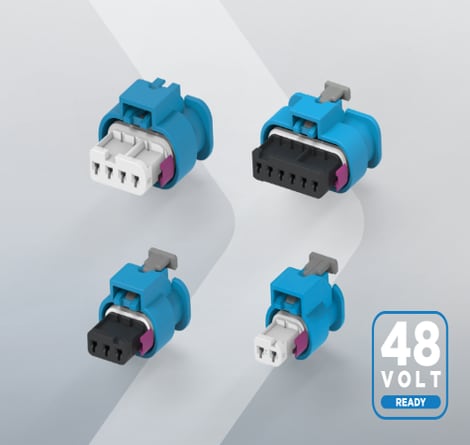
48 Volt Automotive Connectors & Low Voltage Connector System (LVCS) Solutions
Discover TE Connectivity's portfolio of 48V automotive connectors and Low Voltage Connector System (LVCS) solutions, designed to support the transition to next-generation vehicle electrical architectures.
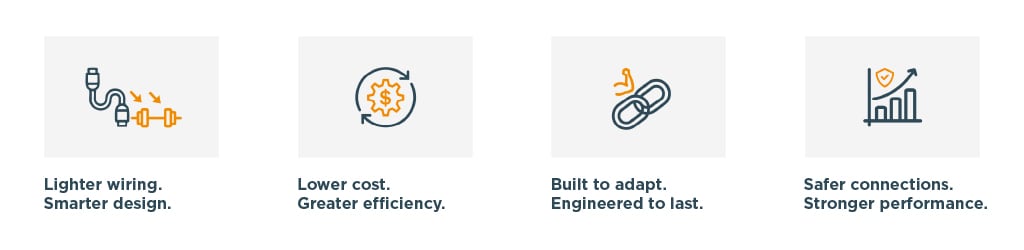
SAFE
Engineered to meet stringent creepage and clearance requirements, ensuring reliable, arc-free performance in high-voltage environments.
SMART
TE’s 48 volt LVCS portfolio reduces cost and complexity while accelerating time-to-market with scalable, production-ready solutions.
LIGHT
TE’s 48 volt connector systems reduce wiring weight and copper usage while enabling more efficient, high-performance vehicle systems.
Built for Next-Generation 48 Volt Automotive Electrical Architecture
As automotive E/E architectures shift to 48V, TE Connectivity delivers a comprehensive portfolio of 48V-ready connector systems designed to meet the demands of next-generation vehicles. Our solutions reduce weight, improve efficiency, and enable scalable, high-performance vehicle systems available today.
Built to meet stringent creepage and clearance requirements and backed by industry standards for 48V systems, TE’s 48V connectors deliver safe, reliable performance across modern automotive applications - helping you transition to 48V with confidence.
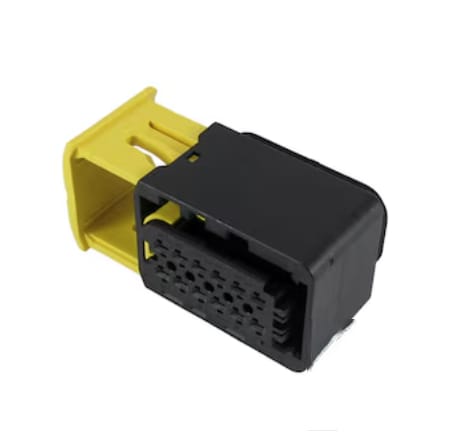
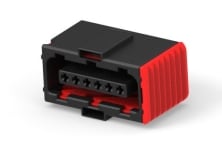
Explore 48 Volt Ready Connector Product Portfolio
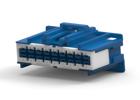
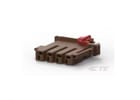
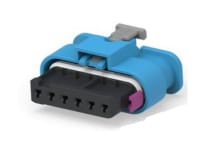 e
 e
 e
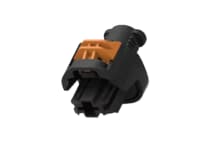 e
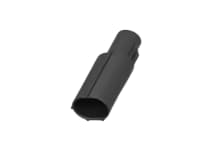 e
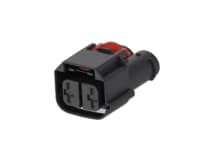 e
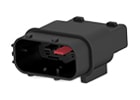


48 Volt Connector Requirements
TE Connectivity’s 48 volt connector systems are engineered to meet stringent creepage and clearance requirements, ensuring safe, arc-free performance in high-voltage automotive environments. Designed for durability, they feature robust locking mechanisms and comply with key automotive standards for reliable operation under harsh conditions.
Our evaluation process considers critical factors including the following to determine the required spacing for safe electrical performance. Connectors with single wire seals and terminal sizes ≥1.2 mm (and some 0.64 mm designs) typically meet 48V requirements due to inherent spacing within the seal design.
- Pollution level
- Material group
- Voltage rating
- Altitude
To support accurate evaluation, TE has developed an internal creepage and clearance calculator. Where needed, design optimization techniques—such as selective cavity population—can be applied to increase terminal spacing and achieve compliance.
The Creepage and Clearance calculator example
The Creepage and Clearance calculator example that is provided here, illustrates the general parameters outlined in the international standard DIN EN 60664-1 guidelines for required distances to ensure safe electrical separation between different circuits. For guidance tailored to your specific application, please consult a TE representative to ensure all requirements are properly addressed.
| INPUTS | |
| Application Voltage: |
60V |
| Pollution Degree (Sealed ): |
2 |
| Pollution Degree (Unsealed ): | 3 |
| Altitude: |
5000 m |
| Overvoltage Category (I-IV): |
I |
| Reinforced Insulation Factor (Clearance): |
1.0 X |
| Reinforced Insulation Factor (Creepage): |
1.0X |
| CLEARANCE | |
| Impulse Voltage: |
500V |
| Required Minimum Clearance (@sea level): |
0.20 mm |
| Altitude Correction Factor: |
1.48 X |
| Required Minimum Clearance (@5000m): |
0.30 mm |
| CREEPAGE |
|
| Material Group: |
IIIa |
| Groove Width: |
1.00 mm |
| Required Minimum Creepage: |
1.24 mm |
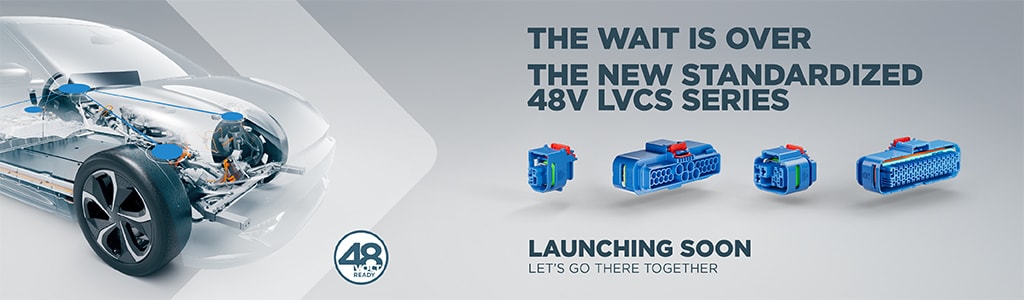
48 Volt Low-Voltage Standard Interface Connectors (LVCS)
ENDPOINT FEMALE - RECEPTACLE HOUSINGS
Product - ENDPOINT FEMALE
|
Product Name
|
POSITIONS
|
TERMINAL SIZE
|
90 DEGREE BACKSHELL COVERS (SIDE AND BACK EXIT)
|

|
MQS Receptacle Housings |
2 4 6 |
0.64mm |
Yes |

|
AMP MCP Receptacle Housing |
2 4 |
2.8mm |
Yes |

|
Mixed MQS & AMP MCP Receptacle Housing |
6
6 |
4 x 0.64mm 2 x 2.8mm
And
4 x 0.64mm 2 x 6.3mm |
Yes
Yes |
This product table can only be viewed on desktop.
ENDPOINT MALE - TAB HOUSINGS


CONTROLLER FEMALE - RECEPTACLE HOUSINGS
Product Name - CONTROLLER FEMALE
|
Product Name
|
POSITIONS
|
TERMINAL SIZE
|
90 DEGREE BACKSHELL COVERS (SIDE AND BACK EXIT)
|

|
MQS Receptacle Housing |
18 28 |
0.64mm |
Yes |

|
Mixed MQS & AMP MCP Receptacle Housing |
12 |
8 x 0.64mm 4 x 2.8mm |
Yes |

|
Mixed MQS & AMP MCP Receptacle Housing |
14 |
12 x 0.64mm 2 x 2.8mm |
Yes |

|
Mixed MQS & AMP MCP Receptacle Housing |
22 |
18 x 0.64mm 4 x 2.8mm |
Yes |

|
Mixed MQS & AMP MCP Receptacle Housing |
24 |
22 x 0.64mm 2 x 2.8mm |
Yes |
This product table can only be viewed on desktop.
CONTROLLER MALE - TAB HOUSINGS
Product Name - CONTROLLER MALE
|
Product Name
|
POSITIONS
|
TERMINAL SIZE
|
90 DEGREE BACKSHELL COVERS (SIDE AND BACK EXIT)
|

|
MQS Tab Housing |
18 |
0.64mm |
Yes |

|
Mixed MQS & AMP MCP Tab Housing |
12 |
8 x 0.64mm 4 x 2.8mm |
Yes |

|
Mixed MQS & AMP MCP Tab Housing |
14 |
12 x 0.64mm 2 x 2.8mm |
Yes |

|
Mixed MQS & AMP MCP Tab Housing |
22 |
18 x 0.64mm 4 x 2.8mm |
Yes |

|
Mixed MQS & AMP MCP Tab Housing |
24 |
22 x 0.64mm 2 x 2.8mm |
Yes |
This product table can only be viewed on desktop.
48 Volt Benefits
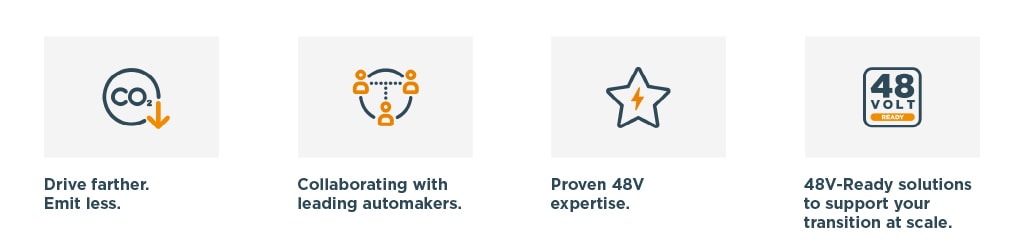
48V is enabling the next generation of vehicle innovation, from autonomous driving systems to intelligent cabins. Combined with zonal architecture, 48V creates a more efficient and scalable electrical backbone by distributing power through intelligent vehicle zones. Discover how 48V architecture is helping shape the future of mobility with smarter features, improved efficiency, and simplified vehicle design. The move to 48V isn’t just an evolution-it’s a revolution.

48V Applications
- Active Suspension
- Roll Stabilization
- Steering-by-Wire
- Anti-Lock Braking System
- Powered Steering System
- Integrated Power Brake
- iBooster Brake System
DRIVETRAIN
- Electric Supercharger
- Water Pump
- Starter
- Engine Cooling Fan
- Fuel Pump
- Starter Generator
- DC/DC Converter
INFOTAINMENT
- Audio Amplifier
BODY CONTROL
- Seat Heater
- Active Body Control
- AC Compressor
- Electric Heating
- Exterior Light
- Windscreen Heater
- Auxiliary Heater
48V Resources
Frequently Asked Questions
Q. What is a 48V automotive electrical architecture?
A. A 48V automotive electrical architecture is a low-voltage electrical network designed to support higher vehicle power demands at lower current levels than traditional 12V systems. It can support high-power vehicle functions while operating alongside other voltage domains within the vehicle.
Q. Why are automakers adopting 48V systems?
A. 48V systems help support growing power demands by delivering the same power at lower current than 12V systems. Lower current can enable smaller conductor sizes, heat losses, decrease harness weight, and help address power-delivery constraints.
Q. How does 48V reduce wiring weight and power loss?
A. For the same power requirement, increasing voltage from 12V to 48V reduces current to one-quarter. This lower current can enable smaller conductor cross-sections, helping reduce copper usage, harness weight, and packaging requirements. Theoretically, for the same resistance, resistive power loss can be reduced to one-sixteenth.
Q. What are the benefits of a 48V electrical system compared with a 12V system?
A. Compared with a traditional 12V system, a 48V electrical system can deliver the same amount of power at significantly lower current. Lower current can enable smaller conductor sizes, helping reduce copper usage, wiring-harness weight, packaging requirements and resistive power losses. A 48V architecture can also support growing electrical loads and higher-power functions while working alongside existing 12V and high-voltage vehicle networks.
Q. How does 48V support zonal vehicle architectures?
A. A 48V power backbone can efficiently distribute power to zone controllers and other higher-power loads. Local DC/DC conversion can then supply nearby 12V devices, helping reduce long 12V cable runs, simplify wiring, and reduce harness weight.
Q. Why do 48V connectors require special design considerations?
A. 48V applications require careful consideration of creepage and clearance distances, current-carrying capacity, wire size, environmental sealing, and secure locking. Connector designs may also need to address electrical arcing during mating or unmating under load, depending on the application. Click here to learn more about evaluating connectors for 48V applications and TE’s 48V evaluation strategy.