Accelerometers measure the acceleration or vibration of a device or system. Physically, the accelerometer can be considered a weight on a spring which is connected to a frame. When the frame is moved, the mass will stay at rest until the spring, being stretched, can exert enough energy to move the mass. The two basic types of accelerometers are piezoelectric (AC response) and MEMS based (DC response) accelerometers.
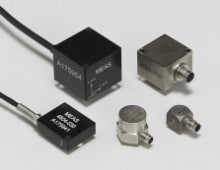
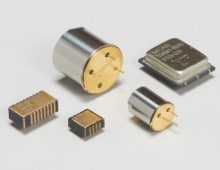
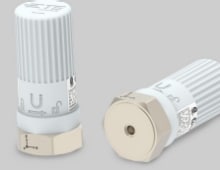
Piezoelectric Accelerometers
AC Response
Voltage mode piezoelectric is the most popular accelerometer design due to its high level output and wide bandwidth. We offer voltage mode accelerometers in the traditional 3-wire or 2-wire (IEPE) configurations.
Charge-mode piezoelectric accelerometers measure shock and vibration in high temperature environments. In addition to its high temperature operating capability when used with a high quality charge amplifier, a charge mode accelerometer offers dynamic range scalability.
MEMS Accelerometers
DC Response
To measure velocity or displacement motion accurately, an accelerometer with DC response is required. Incorporating MEMS technologies and the latest analog and digital ASICs, our DC accelerometers offer high performance and exceptional value. All products are EAR99 and RoHS compliant.
Frequently Asked Questions
What is difference between piezoelectric (PE), piezoresistive (PR) and variable capacitance (VC) accelerometers?
The word “piezo” comes from the Greek word “piezein” which means to press or squeeze. In this case, this refers to a basic characteristic of the material; when pressed or subjected to force, piezoelectric (PE) materials develop an electric charge and piezoresistive (PR) materials exhibit a change in resistance. Variable Capacitance (VC) sensors are essentially accelerometers that derive the acceleration measurement from a change in capacitance of a seismic mass moving between two parallel capacitor plates. These are the principles of operation of most accelerometers in use today.
What does the term "damping" refer to in piezoresistive accelerometers?
By providing a narrow gap between two large moving plates, air is displaced, and this displacement slows the motion of the mass, thus damping the movement. If the gap is not well-controlled, the piezoresistive accelerometer may be either grossly underdamped or overdamped. The problem with overdamping is the loss of useful bandwidth from the sensor. For underdamped devices, the accelerometer is more prone to signal distortion and breakage when excited near the peak response. For instance, a device with a Q of 10 will indicate 10 times gain at resonance and a 1g acceleration input will excite the seismic mass to 10g.