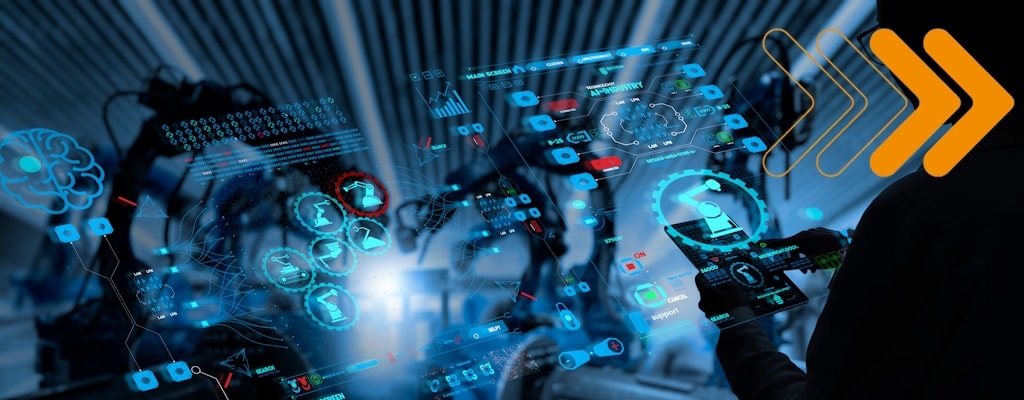
AI MACHINE VISION
Industries
Helping Transform the Way Raw Visual Data Is Processed & Applied
From high resolution image capture to AI processing, storage, and system output.
AI Machine Vision systems convert visual data into realtime, actionable intelligence for automation, robotics, and edge AI applications.
From high resolution image capture to AI processing, storage, and system output, reliable connectivity is critical at every stage. TE Connectivity (TE) delivers a broad, system level connector portfolio engineered to help support high performance and scalability across both traditional machine Vision and embedded AI vision architectures.
What is Machine Vision?
- Machine vision focuses on engineered, real‑time industrial tasks (inspection, measurement, robot guidance).
- Computer vision is broader (medical imaging, autonomous driving, consumer applications).
Image Acquisition - Cameras capture images using CMOS/CCD sensors with proper illumination. Lighting—bright field, dark field, backlighting, infrared.
Decision Making & Communication - The system sends results (pass/fail, measurements, object location) to robots or controllers.
Optics - Lenses control field of view, magnification, and depth of field.
Image Processing - Algorithms enhance and analyze the image (e.g., filtering, contrast, pattern detection, segmentation).
Feature Extraction - Edges, defects, shapes, colors, barcodes, and 3D information are identified.
- Machine vision focuses on engineered, real‑time industrial tasks (inspection, measurement, robot guidance).
- Computer vision is broader (medical imaging, autonomous driving, consumer applications).
Connectivity Challenges in AI Machine Vision Architectures
As machine vision systems evolve toward higher resolutions and AI driven inference, connectivity infrastructure must support image acquisition, AI processing, data storage, and system communication across increasingly complex architectures.
Industry Needs for Successful AI Machine Vision Implementation
- Low-Latency Image Transfer - Provide clean, low-latency image data transfer from camera sensors to processing hardware.
- High-Bandwidth Camera Connectivity - Stable, high-bandwidth camera interfaces to preserve image quality and inference accuracy.
- Efficient AI Data Movement - Transfer image data efficiently within AI processing architectures.
- High-Speed Processing Connectivity - Dense, high-speed board-to-board connectivity.
- Fast, Reliable Storage - Support local and high-speed storage of image data, AI models, and inference results.
- Reliable System Communication - Deliver AI results to machines, networks, and operators.
- Standards-Based Interoperability - Provide compatibility with established standards (GigE Vision, USB3 Vision, COM Express, and MIPI CSI-2).
- Industrial Reliability - Provide waterproof, shock-resistant solutions for harsh industrial environments.
- Edge AI Enablement - Provide miniaturized, high-speed interconnects that support low-latency processing design trends.
- Low-Latency Decision Making - Support low-latency, on-device decision making.
- System Miniaturization & Power Efficiency - Address system miniaturization and power efficiency requirements.
AI machine vision is evolving from centralized inspection systems to intelligent, embedded vision at the edge. TE Connectivity helps enable this evolution with a comprehensive interconnect portfolio designed to deliver reliable performance across every system function—helping transform the way raw visual data is processed and applied.
TE Solutions Across AI Machine Vision Architectures
TE delivers a broad, system level connector portfolio engineered to help support high performance and scalability across AI machine vision architectures.
The products shown below are suggested examples from TE’s commercial portfolio for customers to evaluate as part of their design and development process. Customers are responsible for all part selection decisions for their applications and determining suitability for end use.
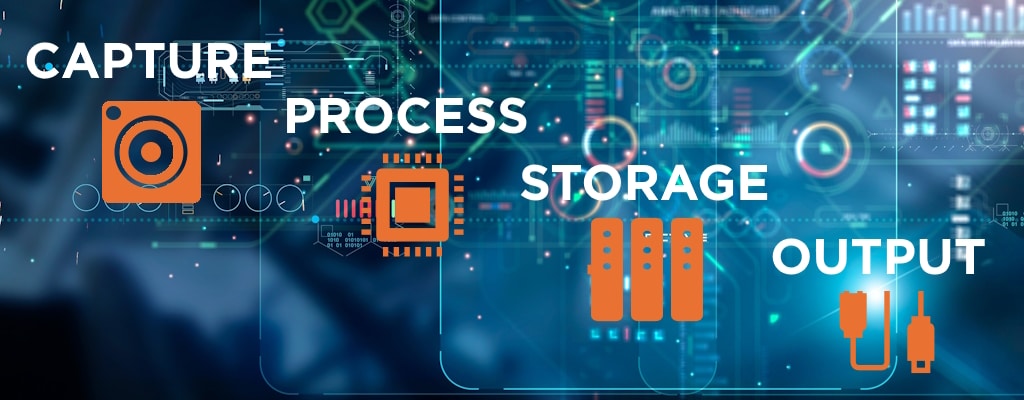
Capture Systems – Reliable Image Acquisition
Provide clean, low latency image data transfer from camera sensors to processing hardware
TE Connectivity helps enable vision systems to see clearly and consistently, delivering high speed, low loss connectivity from image sensor to processor—across industrial, embedded, and edge AI environments.
Applications
- Factory automation and inspection cameras
- Robot guidance and 3D vision systems
- Embedded cameras and smart cameras for edge AI

 e
e
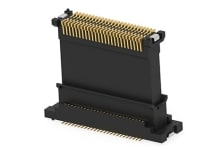
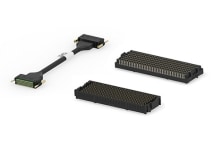
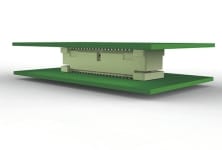
Process Systems – AI Compute & Data Movement
Transfer image data efficiently within AI processing architectures
TE Connectivity supports AI decision making at the edge and in industrial systems with high speed, high density interconnect solutions designed for performance, reliability, and scalability.
Applications
- Industrial PCs (IPCs) and AI controllers
- GPU, FPGA, and AI accelerator architectures
- Modular and scalable embedded vision systems
 e
e
 e
e
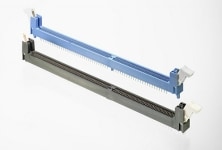
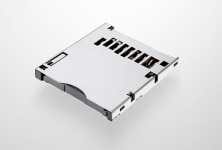
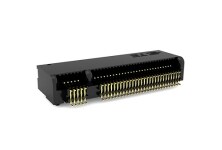
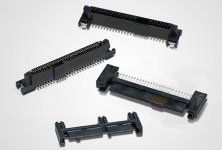
Storage Systems – Data & Model Retention
Support local and high speed storage of image data, AI models, and inference results
TE Connectivity helps machine vision systems stay responsive and data ready with proven, scalable storage interconnect solutions—from embedded devices to high performance architectures.
Applications
- AI model storage and updates
- Image buffering and logging
- High speed inference memory
 e
e
 e
e
 e
e
 e
e
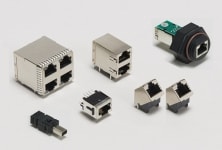
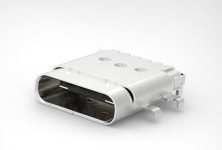
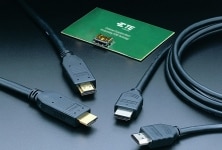
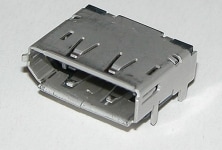
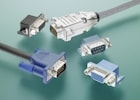
Output Systems – Communication & Visualization
Deliver AI results to machines, networks, and operators
TE Connectivity helps ensure AI vision insights are delivered reliably, connecting vision systems to machines, networks, and people with trusted I/O solutions.
Applications
- Robot and PLC control
- Operator visualization and monitoring
- Networked automation systems
 e
e

 e
e
 e
e
Why TE Connectivity?
TE combines broad connectivity experience with application experience across industrial, automotive, communications, and embedded computing environments.
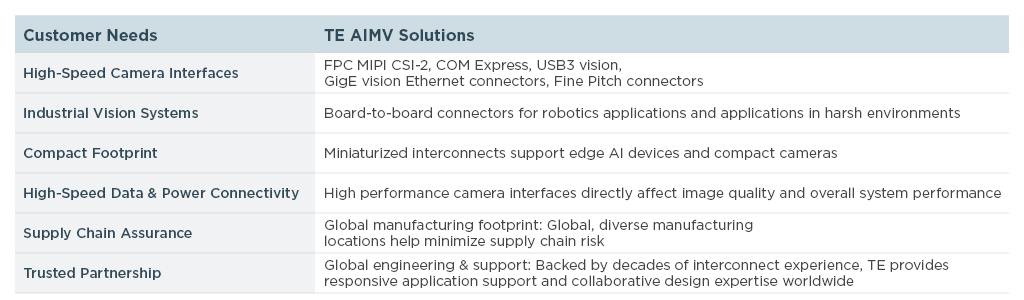
Combined with global engineering and manufacturing capabilities, TE helps customers support evolving AIMV architectures from development through scaled deployment.
Supporting the Next Generation of AI Machine Vision
AI machine vision is evolving from centralized inspection systems to intelligent, embedded vision at the edge. TE Connectivity helps enable this evolution with a comprehensive interconnect portfolio designed to deliver reliable performancea cross every system function—helping transform the way raw visual data is processed and applied.
TE Connectivity is helping customers address these emerging challenges with connectivity solutions designed to support evolving AIMV architectures.



TE, TE Connectivity, TE connectivity (logo), MezzaWave, and EVERY CONNECTION COUNTS are trademarks owned or licensed by the TE Connectivity plc family ofcompanies. Other product names, logos, and company names mentioned herein may be trademarks of their respective owners.While TE has made every reasonable effort to ensure the accuracy of the information in this document, TE does not guarantee that it is error-free, nordoes TE make any other representation, warranty or guarantee that the information is accurate, complete, correct, reliable or current. TE reserves theright to make any adjustments to the information contained herein at any time without notice. TE EXPRESSLY DISCLAIMS ALL IMPLIED WARRANTIESREGARDING THE INFORMATION CONTAINED HEREIN, INCLUDING, BUT NOT LIMITED TO, ANY IMPLIED WARRANTIES OF MERCHANTABILITY ORFITNESS FOR A PARTICULAR PURPOSE. In no event will TE be liable for any direct, indirect, incidental, special or consequential damages arising from orrelated to recipient’s use of the information. It is the sole responsibility of recipient of this information to verify the results of this information using theirengineering and product environment. Recipient assumes any and all risks associated with the use of the information. Antenna performance may vary. TE is a component manufacturer, and customer and/or end-user is responsible for all end-use compliance and regulatory requirements. These marketingmaterials do not constitute an order or agreement of sale, and TE Connectivity shall be bound by and subject to only those terms and conditions set forthin a written agreement referencing specific products and signed by an authorized representative of TE.