NTSEAL Connectors
Frequently asked questions
Q: What is an NTSEAL connector
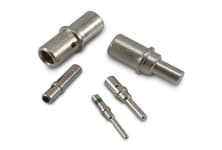
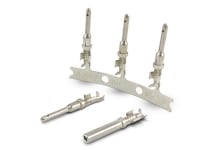
A: NTSEAL is part of TE’s DEUTSCH connector line. It is a family of high density, hybrid, sealed wire to wire connectors available in 18, 20, 26, 36, 38 and 48 positions that use DEUTSCH size 12, 16 and 20 contacts.
Q: What do TPA and CPA mean
A: TPA is Terminal Position Assurance and supports correct contact installation. CPA is Connector Position Assurance and supports correct assembly and helps guard against accidental unmating.
Q: What sealing and temperature ratings apply
A: With backshell, NTSEAL is rated IP67 IP68 and IP6K9K. Operating temperature ranges from -40º to 125ºC (-40° to 257°F).
Q: Which markets can I spec in NTSEAL connectors?
A: NTSEAL connectors can be applied to various fields such as truck, bus, construction, agricultural industries, and various industries and applications.
Q: What are the appropriate applications for the NTSEAL connectors?
A: NTSEAL connectors can be applied via inline wire-to-wire or panel-mount for engine, chassis, after-treatment, and automation.
Q: What are the key features and benefits of the NTSEAL system?
A:
- Optimal flexibility with hybrid cavities and flange mount options
- Ensures a tight seal and minimizes damage during repair with DEUTSCH contacts without locking lance
- Integrated Terminal Position Assurance (TPA) and Connector Position Assurance (CPA)
- Integrated locking lever for easier mate/unmate operation
Q: What is the IP rating of the NTSEAL connector portfolio?
A: IP67, IP68 and IP6K9K sealing levels (with backshell).
Q: What is the operating temperature of NTSEAL connectors?
A: About -40°C to 125°C.
Q: What is the operating current of NTSEAL connectors?
A: 7.5 A / 13 A (at 125°C).
Q: What are the materials of the NTSEAL connector?
A: PBT for the housing and silicone for the sealing.
Q. What accessories are available for use with NTSEAL connector?
A. NTSEAL connector accessories include backshells, mounting rings, sealing plugs and mounting clips.
NTSEAL Pin Housings for Male Terminals
Frequently Asked Questions
Q: What is an NTSEAL housing for male terminals, and how does it differ from the plug version?
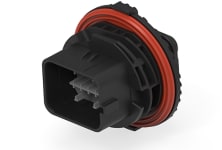
A: In the NTSEAL connector family, the housing for male terminals is the pin housing sometimes called the receptacle in the catalog. It mates with the plug that carries socket contacts. Pin housings are offered with or without a flange for panel mount and are color coded and keyed to avoid cross mating. See the position tables and coding examples on pages 3 through 8 of the datasheet.
Q: What ingress protection do these housings achieve in the field?
A: When used with the matching backshell, NTSEAL achieves IP67, IP68, and IP6K9K for dust, immersion, and high pressure spray. This rating supports under hood, chassis, and washdown environments..
Q: What temperature and vibration performance should I design for?
A: Operating temperature is 40° to 125°C (-40° – 257°F). The series is described as suitable for engine level vibrations, which is why it is used around engines, e motors, transmissions, and frames.
Q: What system voltage and contact current does the housing support?
A: NTSEAL is used in 12 volt and 24 volt vehicle systems. Contact current depends on contact size at 125°C: about 7.5 A for size 20, 13 A for size 16, and 25 A for size 12.
Q: Which DEUTSCH contacts fit these male terminal housings and what wire sizes can I use?
A: NTSEAL uses the DEUTSCH common contact system in sizes 20, 16, and 12. Typical wire ranges are 0.5 to 1.5 mm² for size 20, 1.0 to 2.5 mm² for size 16, and 2.0 to 6.0 mm² for size 12.
Q: What position counts are available for male terminal housings?
A: The family covers 18, 20, 26, 36, 38, and 48 positions. Contact mixes vary by shell size, letting you combine power and signal in one connector. See pages 3 through 8 of the datasheet for pin housing options by size.
Q: Do the housings include safeguards for contact retention and latch security?
A: Yes. TPA is a terminal position assurance feature that helps confirm each crimped contact is fully seated. CPA is a connector position assurance feature that helps keep the latch in the locked state after mating. Both are integrated into the system. See the feature list on page 1 of the datasheet.
Q: Is there an assisted mating option for higher pin counts?
A: The 26, 36, 38, and 48 position connectors include an integrated locking lever to support mating and speed assembly.
Q: What panel mount choices exist for pin housings, and how do I pick the right ring?
A: Pin housings are available with a flange for panel mount or without a flange for in line use. Mounting rings are color coded for common panel thickness values, for example 1.5, 3.0, 3.5, and 4.0 mm. See the mounting ring tables near each shell size in the datasheet.
Q: Which backshells and accessories pair with male terminal housings?
A: Backshells are offered in one hundred eighty degree and ninety degree outlets. The ninety degree can rotate a full three hundred sixty degrees when used with the 180° base. Accessories include sealing plugs, sealed caps, and mounting clips.
Q: What coding options prevent mis mating during service?
A: Four coding options labeled A, B, C, and D are offered. They are also color coded (black, grey, green, blue) to help technicians match pairs on the line and in the field.
Q: What materials are used for the housing and lock features?
A: The housing, CPA, and TPA are made of PBT. This choice balances strength, stability, and chemical resistance for transportation environments.
Q: Where do I find crimping and assembly guidance or test details?
A: Use the Application Specification 114-32209 for termination and assembly practices and the Product Specification 108-101662 for performance details.
Q: How do I decide which contact mix to use for my harness area, for example engine bay versus battery and charging?
A: Match the current and wire size first, then the position count and IP rating needed for that area. For example, select size 12 cavities when you need contact currents around 25A at 125°C and plan for IP6K9K where high pressure spray occurs.
NTSEAL Socket Housings for Female Terminals.
Frequently Asked Questions
Q: Are these the housings for female terminals (socket contacts)?
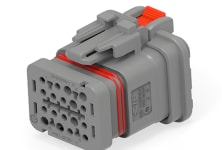
A: Yes—these are plugs (socket housings) in the NTSEAL connector (or appropriate) family, intended for socket (female) contacts.
Q: How do I pick between “with CPA” and “without CPA”?
A: If you want an added secondary lock to reduce accidental un-mating in service, choose with CPA. For certain packaging/service needs, 20-position socket housings are also offered without CPA.
Q: What do I need to reach IP6K9K?
A: IP6K9K sealing can be achieved with a backshell.
Q: What contact sizes fit these socket housings?
A: NTSEAL connectors uses DEUTSCH contacts size 20, 16, and 12 contacts, depending on the position count/contact arrangement.
Q: What if I’m not populating every cavity?
A: Use the specified sealing plugs for unused cavities to maintain environmental protection.
Q: Can I order caps/clips for protection and mounting?
A: Yes—sealed caps and mounting clips are listed as NTSEAL connector accessories.
NTSEAL Connector Cavity Plugs
Frequently Asked Questions
Q: What are NTSEAL connector cavity plugs used for?
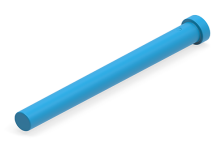
A: They fill unused cavities in an NTSEAL connector so open cavity locations are sealed when a contact is not installed.
Q: How do I choose the right NTSEAL connector cavity plug?
A: Match the plug to the cavity diameter in your connector housing (1.9 mm, 2.0 mm, or 2.5 mm). Then select the correct part number and color for your build and connector configuration.
Q: What temperature range do these NTSEAL connector sealing plugs support?
A: The operating temperature range is -40 to 125°C.
Q: What material are these connector cavity plugs made from?
A: The material is PBT GF15 (a reinforced plastic).
Q: Do I need cavity plugs if my NTSEAL connector has optional circuits?
A: If your design leaves some cavities unused (common with platform variants), cavity plugs can help keep unused cavities closed while you populate only the circuits you need.
NTSEAL connector Fixing Rings
Frequently Asked Questions
Q: How do I pick the right NTSEAL connector fixing ring?
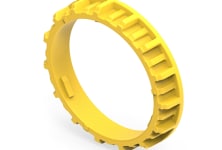
A: Match the NTSEAL connector mounting ring to your panel thickness. The 2366517 options cover 1.5 mm, 3.0 mm, 3.5 mm, and 4.0 mm panels, each with a defined color and part number.
Q: What are the part numbers for NTSEAL connector mounting ring options by thickness?
A: 1.5 mm: 2366517-1 (yellow). 3.0 mm: 2366517-2 (grey). 3.5 mm: 2366517-3 (green). 4.0 mm: 2366517-4 (blue).
Q: What material and temperature range should I plan around?
A: NTSEAL connectors and accessories have operating temperature of -40 to 125 °C .
NTSEAL connector Backshells and Caps
Frequently Asked Questions
Q: How do I choose between an NTSEAL connector backshell and an NTSEAL connector cap?
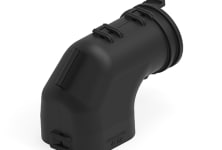
A: Use an NTSEAL connector backshell when you need a controlled cable exit direction (90° or 180° depending on part). Use an NTSEAL connector cap when the connector is unmated and you want interface coverage during staging, storage, or service.
Q: When should I pick 90° vs 180° cable exit?
A: A 90° exit can help when the cable must turn immediately due to packaging limits. A 180° exit can help when the cable can run straight first and bend later. Both options are available in the NTSEAL connector backshells and caps family, depending on the part number.
Q: What environmental ratings apply to NTSEAL backshells connector and caps?
A: These accessories feature-40°C to 125°C operating temperature range and IPX4/IPX8 sealing . For sealing targets at the connector system level, our NTSEAL connector documentation references sealing levels (with backshell) depending on configuration.
 e
e
 e
e
 e
e
 e
e
 e
e