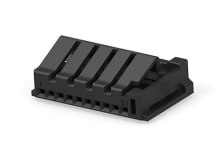
 e
e

Get to know PicoMQS miniaturized automotive connector system, the latest addition and solution to the successful NanoMQS and MQS product families.
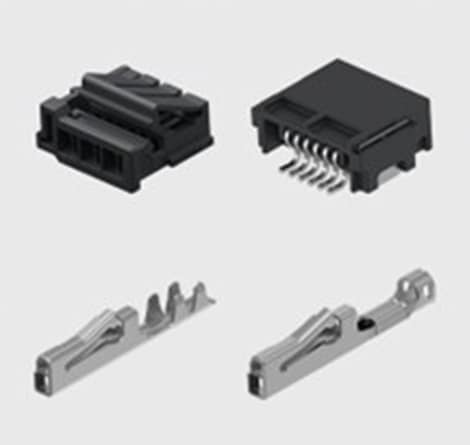
Miniaturized PicoMQS Vehicle Interconnection System
Deliver reliable signal connectivity in compact vehicle electronics with TE Connectivity's PicoMQS miniaturized automotive connector system. Designed for space-constrained, unsealed signal interfaces, PicoMQS combines a compact 1.27 mm pitch, LV214 qualification, and proven automotive-grade reliability to support smaller, lighter vehicle designs.
1.27
Pin Pitch
78%
Reduced packaging weight (compared to MQS)
LV214
Smallest LV214 qualified crimped connection with Class 2 vibration stability
Automotive-grade connectivity for the smallest spaces
As vehicle electronics become more connected, electrified, and compact, engineers need signal connector systems that reduce size and weight without compromising reliability. TE's PicoMQS miniaturized automotive connector system delivers LV214-qualified connectivity for compact, unsealed signal interfaces. Featuring a 1.27 mm pitch and automotive-grade performance, PicoMQS helps optimize packaging, reduce weight, and increase design flexibility for battery management systems (BMS), headlamps, steering wheel controls, cameras, sensors, and other compact vehicle electronics.


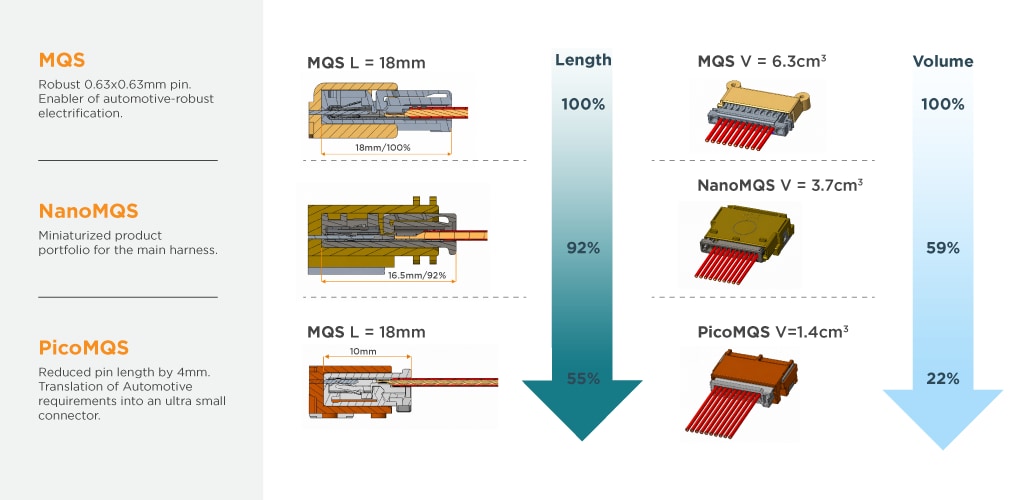
Evolution of the PicoMQS Miniaturized Signal Connector System
Explore PicoMQS Product Portfolio
PicoMQS Miniaturized Signal Connectivity Benefits
- Maximize packaging efficiency
Support the smallest automotive electronic modules with a 1.27 mm pin pitch, 78% lower packaging weight than MQS, 30% tighter pin spacing, and a 55% shorter crimp length, while maintaining full LV214 qualification.
- Deliver reliable automotive performance
Maintain dependable signal connectivity in harsh environments with Class 2 vibration stability, operating temperatures up to 150°C, and continuous current capability up to 4 A.
- Ensure secure electrical connections
Improve connection reliability with the smallest LV214-qualified crimped connection, featuring anti-scooping protection, secondary locking, and Kojiri alignment.
- Simplify automated manufacturing
Increase manufacturing efficiency with automated pin insertion and an optimized S-bend solder pin design that reduces header pin length by 42%, helping enable compact PCB layouts.
PicoMQS TERMINAL SYSTEM
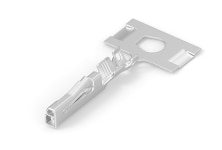
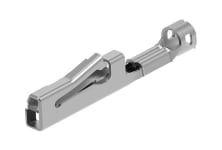
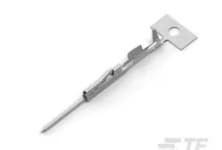
PicoMQS signal terminals combine ultra-miniaturized packaging with reliable electrical performance for high-density automotive electronics. The terminal architecture supports currents up to 4 A across wire sizes from 0.13 mm² to 0.22 m² while maintaining Class 2 vibration stability and meeting LV214 requirements. Features such as anti-scooping protection and secondary locking help ensure secure, reliable connections in demanding applications including battery management systems (BMS), lighting modules, steering wheel controls, cameras, sensors, and power electronics.
Features
- 0.13mm² to 0.22mm² wire range
- Mating for 0.5mm x 0.4mm blade size
- Automotive standard compliant (LV214)
- SG2 Vibration Grade (unsealed)
- 55% Reduction in crimp length
- Locking lance design
- Primary and secondary contact locking
- Robust anti-scooping features help protect terminals during mating and assembly
- Max. temperature130°C (Sn) / 150C (Ag)
- FFC Terminals for complex space constraints and automated assembly of modules
Explore PicoMQS Terminal Portfolio
PicoMQS CONNECTOR SYSTEM
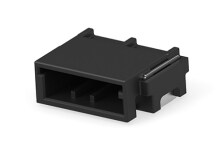
PicoMQS signal connectors extend the advantages of the PicoMQS terminal system into a compact connector platform optimized for high-density automotive electronics. The ultra-compact 1.27 mm pitch architecture is available in single-row 2–10 and 22-position configurations, enabling flexible packaging for battery systems, lighting modules, cameras, sensors, steering controls, and other compact electronic applications.
Features
- Space-saving design: Reduce connector packaging by up to 78% compared with MQS, enabling compact, smaller, lighter, high-density electronic modules.
- Reliable connector alignment: Kojiri connector design helps support secure mating in space-constrained applications.
- Automotive-qualified performance: Designed to meet LV214 requirements, helping support reliable connector performance in demanding automotive signal connectivity applications.
MQS Automotive Connector Family
| Category | Terminal Family | Wire Size (mm²) | Maximum Current | Tab Size (mm) |
|---|---|---|---|---|
| Miniaturized | PicoMQS 0.50 | 0.13–0.35 (0.22 FLU/FLR) | 4 A | 0.50 × 0.40 |
| NanoMQS 0.50 | 0.13–0.35 | 6 A | 0.50 × 0.40 | |
| Signal | MQS 0.63 | 0.08–0.75 | 7.5 A | 0.63 × 0.63 |
| Low-to-Medium Power | MQS 1.5 | 0.35–1.50 | 15 A | 1.50 × 0.63 |
| MPQ 2.8 | 0.35–4.00 | 26 A | 2.80 × 0.63 | |
| PQ 5.2 | 1.50–6.00 | 45 A | 5.20 × 0.63 |
PicoMQS HEADER SYSTEM
PicoMQS headers maximize PCB utilization by reducing board footprint by up to 78% compared with TE’s MQS platform. Available with surface-mount (SMT), through-hole (TH), and press-fit terminations, the portfolio gives engineers greater flexibility to optimize PCB board layout, connector orientation, and assembly processes. Built on TE’s proven MQS and NanoMQS connector family architecture, PicoMQS headers simplify integration while delivering reliable board-level connectivity for high-density automotive electronics. Built on TE's MQS and NanoMQS connector family architecture, PicoMQS headers provide a migration path for engineers seeking greater packaging density while leveraging familiar TE connector technologies.
Features
- S-Bended pins save up to 30% of PCB space (compared to Z&J type)
- Surface Mount Technology
- Reduced pin length by 4mm (42% shorter length)
- 2 – 10 and 22 positions
- Through-Hole technology available
- Solder-free assembly: NanoMultispring Press-Fit Pin Technology
- 1.27mm pin pitch (30% reduction)
Learn More About PicoMQS – Video (English)
PicoMQS Automotive Applications
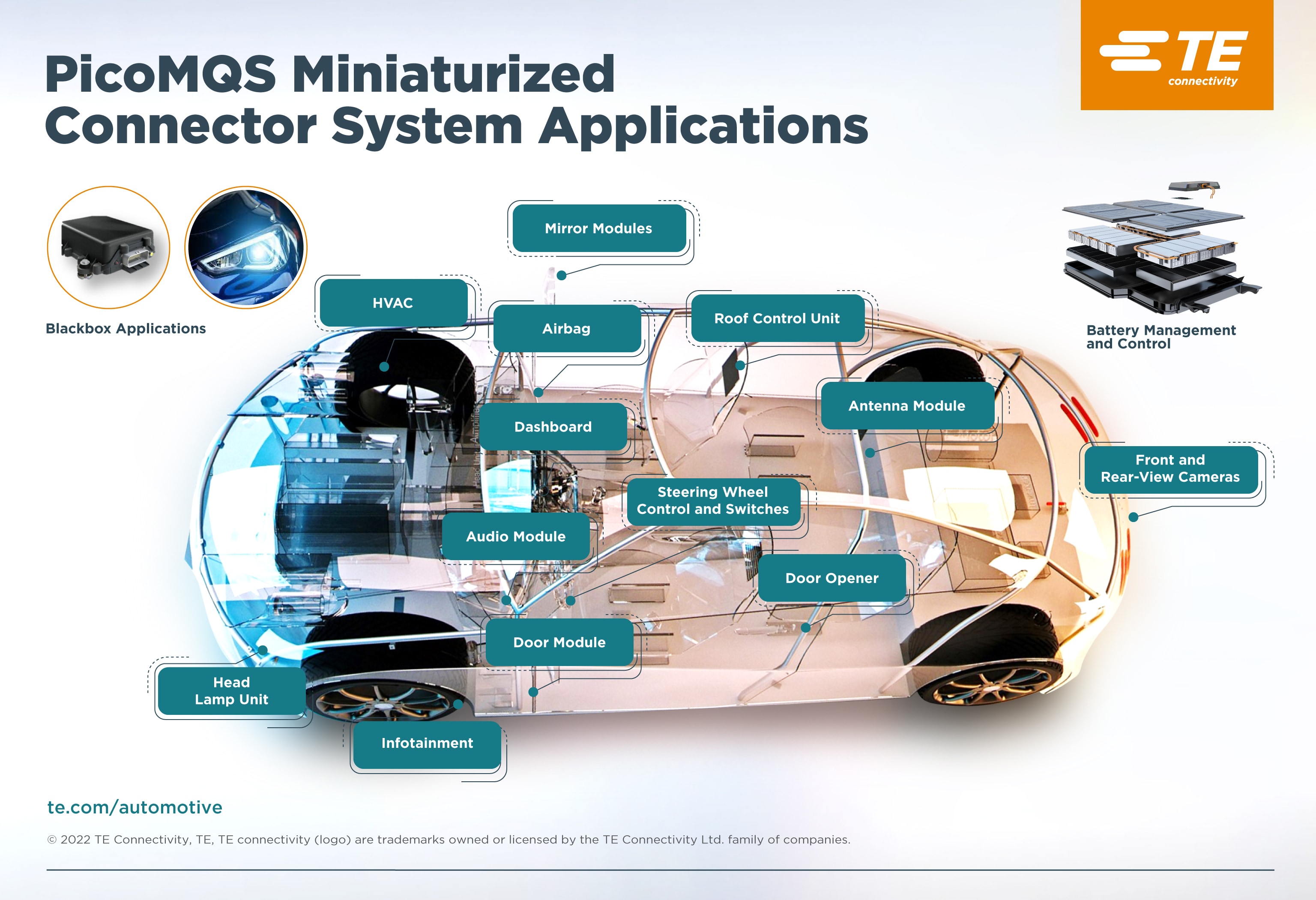
- Mirror Modules
- HVAC
- Airbag
- Dashboard
- Audio Module
- Head Lamp Unit
- Blackbox applications
- Infotainment
- Door Module
- Roof Control Unit
- Antenna Module
- Door Opener
- Front and Rear-view cameras
- Steering wheel controls and switches
Frequently Asked Questions
1. What is the PicoMQS connector system?
TE's PicoMQS connector system is an ultra-miniaturized signal interconnection solution designed for compact automotive electronic modules. The portfolio includes terminals, connectors, and PCB headers that help engineers reduce packaging size and weight while delivering reliable signal connectivity in demanding automotive environments.
2. What makes PicoMQS different from MQS?
PicoMQS builds on TE's proven MQS technology while offering a significantly smaller footprint for space-constrained applications. Compared with MQS, PicoMQS provides up to 78% lower packaging weight, a 1.27 mm pin pitch, and a 55% shorter crimp length, helping engineers maximize PCB utilization and packaging efficiency without compromising automotive-grade performance.
3. Why choose PicoMQS for compact automotive electronics?
PicoMQS is designed for applications where PCB space, weight, and packaging are critical. Its ultra-miniaturized architecture, LV214 qualification, vibration-resistant design, and flexible terminal, connector, and header options help engineers optimize compact electronic modules while maintaining reliable signal connectivity.
4. Which applications is PicoMQS designed for?
PicoMQS is ideal for space-constrained automotive electronic modules, including:
• Mirror Modules
• HVAC
• Airbag
• Dashboard
• Audio Module
• Head Lamp Unit
• Blackbox applications
• Infotainment
• Door Module
• Roof Control Unit
• Antenna Module
• Door Opener
• Front and Rear-view cameras
• Steering wheel controls and switches
5. Is PicoMQS suitable for battery management systems (BMS)?
Yes. PicoMQS is well suited for battery management systems where compact packaging, reliable signal transmission, and vibration resistance are important. Its small footprint helps maximize PCB space while supporting the reliable electrical connections required within BMS modules.
6. What wire sizes and current ratings does PicoMQS support?
PicoMQS terminals support wire sizes from 0.13 mm² to 0.22 mm² and continuous current up to 4 A, depending on the application, conductor size, and operating conditions. This makes PicoMQS suitable for low-current signal applications requiring compact, high-density connectivity.
7. Is PicoMQS qualified for automotive applications?
Yes. PicoMQS is designed to meet LV214 requirements and supports SG2 vibration performance for unsealed applications. The system is engineered to provide reliable signal connectivity in demanding automotive operating environments with temperature capability up to 130°C (Sn) and 150°C (Ag), depending on the plating option.
8. How does PicoMQS help reduce PCB space?
PicoMQS helps maximize PCB utilization through its ultra-compact 1.27 mm pitch, miniaturized connector architecture, and compact PCB headers. Features such as S-bended header pins, reduced pin length, and high-density connector layouts help engineers optimize board space in compact electronic modules.
9. What connector and PCB header options are available?
The PicoMQS portfolio includes:
• Single-row connectors in 2–10 and 22-position configurations
• Optional Connector Position Assurance (CPA) on selected connector variants
• PCB headers with surface-mount (SMT), through-hole (TH), and NanoMultispring Press-Fit technologies.
These options provide flexibility for a variety of PCB layouts and manufacturing processes.
10. Does PicoMQS support automated manufacturing?
Yes. PicoMQS is designed to support efficient manufacturing with features including automated pin insertion, FFC terminal options for complex packaging requirements, and NanoMultispring Press-Fit technology for solder-free PCB assembly. These features help simplify assembly while supporting high-volume automotive production.
11. How does PicoMQS improve reliability in high-vibration applications?
PicoMQS incorporates several design features that help maintain reliable electrical connections in demanding automotive environments, including SG2 vibration performance (unsealed), robust anti-scooping features, a locking lance design, primary and secondary contact locking, and optional Connector Position Assurance (CPA) on selected connector configurations.
12. Where can I find PicoMQS technical drawings, specifications, and part numbers?
Technical documentation, product specifications, compatible part numbers, 3D models, and application information are available on the TE product pages for the PicoMQS portfolio. Engineers can also access datasheets, product drawings, and supporting resources to help select the appropriate terminals, connectors, and headers for their application. Refer to the PicoMQS product portfolio links on this page for more information.
13. Can PicoMQS be used in other industries?
Yes. While PicoMQS was developed primarily for automotive applications, its technical characteristics make it suitable for other industries that require compact, reliable, low-current signal connectivity. Whether it's appropriate depends on the environmental, regulatory, and performance requirements of the specific application.
Potential applications beyond automotive include:
•Industrial Automation
•Commercial Vehicles
•Off-Highway Equipment
•Two- and Three-Wheel Vehicles
•Other compact electronic systems
Wire Termination and Crimping
APPLICATION TOOLING
The challenge of achieving automotive grade robustness is not limited to connector components but also extends to the wire termination and crimping process. That means application tooling also plays a vital role in providing true automotive vibration resistance. Smaller wire and terminal sizes create much greater complexity in the termination process. Thinner wires are extremely flexible and can be difficult to maneuver, accurately position and properly strip.
Additionally, smaller terminal sizes require precision wire placement into the wire barrel to prepare for a quality crimp. Any manufacturing tolerances between the crimper and anvil tools can result in flash, twisting, or other non-conformances. That means, as terminals miniaturize, the entire wire handling and crimping process must be re-imagined to deliver true automotive-grade crimp quality.
For PicoMQS contacts to achieve this, we have been collaborating with our Application Tooling department early in the development stage, to ensure we can offer a complete component and tooling solution. In the case of crimping, it means our tooling solutions are pre-tested against automotive standards requiring no further OEM certification.
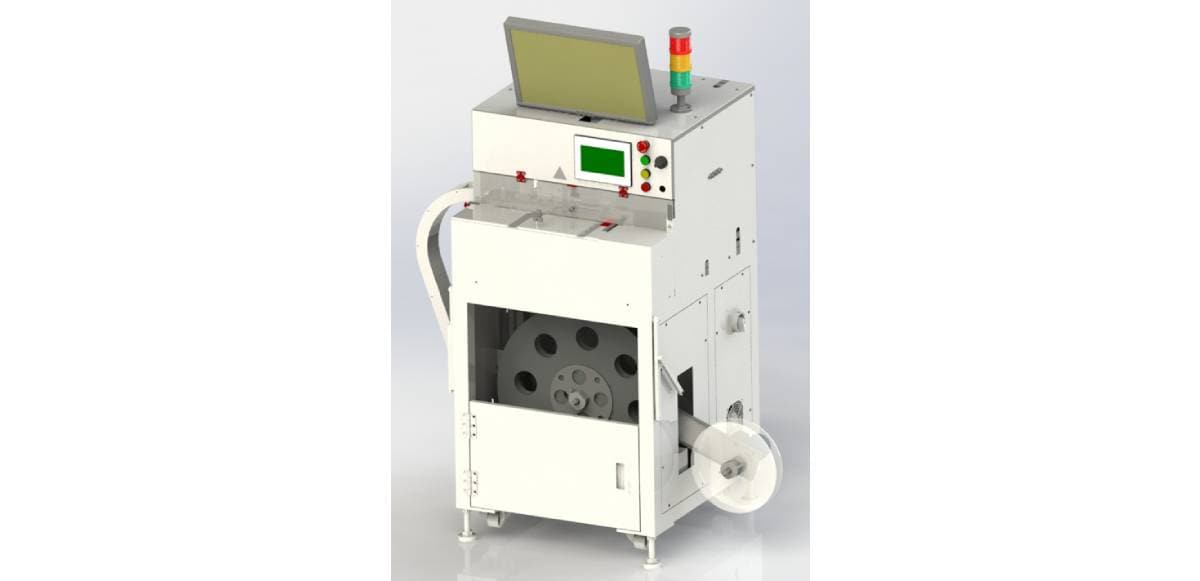
FFC & FPC Cable Termination Machine
For PicoMQS FFC Terminal
The new semi-automatic FFC and FPC termination machine provides a new high-performance crimping solution for PicoMQS FFC Terminal with quality process control, compatibility and parameter visualization.