From Visibility to Detection: Rethinking Avian Collision Mitigation
Author: David Monahan
Business Development Manager, Wildlife & Asset Protection
TE Connectivity
As power grids expand to support electrification, renewable energy, data centers, and industrial growth, utilities are facing rising expectations to deliver infrastructure that is both reliable and environmentally responsible.
One growing priority is avian collision mitigation. Overhead lines can create collision risks for birds, particularly where transmission and distribution corridors cross wetlands, flyways, water bodies, and other sensitive habitats. For utilities and developers, the challenge is no longer whether to act, but how to deploy solutions that are scientifically informed, practical, and scalable.
A systematic U.S. review estimated that 12–64 million birds are killed each year on U.S. power lines [1]
Avian Protection Is Becoming a Grid
Planning Priority
Bird flight diverters are among the most practical mitigation options for existing overhead infrastructure, especially where routing changes or undergrounding are not feasible. They can be retrofitted to targeted spans and deployed across high-risk corridors without major system redesign.
However, not all diverters perform equally. Differences in size, contrast, movement, low-light visibility, and spacing can affect how early birds detect a line and change course. This is driving a shift from generic wire marking toward performance-based diverter selection.
Why Visibility Alone Is Not Enough
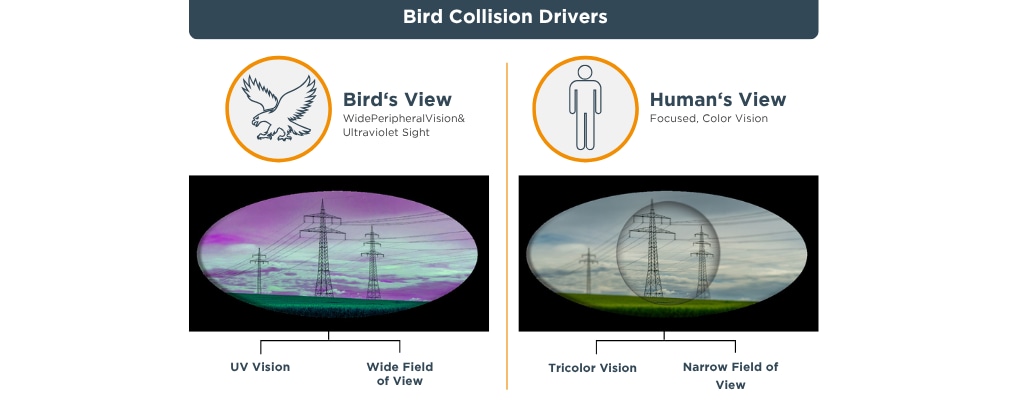
Historically, some diverter designs were based on human visibility: if a person could see the marker, it was assumed birds could see it too. Research into avian vision shows that this approach is incomplete.
Birds perceive their environment differently than humans. Many species rely on lateral vision, detect objects in a forward-peripheral field, and experience reduced visual resolution in low-light conditions. A marker that appears visible to a person may not be detected early enough by a bird in flight to prevent a collision.
The most vulnerable species are often large or less maneuverable birds, including bustards, storks, waterbirds, and waders — groups that can
have limited forward vision [2]
Designing For Detection
Performance-based diverter design considers the conditions that influence whether a bird can identify a line in time. Key factors include:
• High contrast
• Adequate visual size
• Detectable patterning
• Wind-driven movement
• Low-light performance
• Species-appropriate spacing
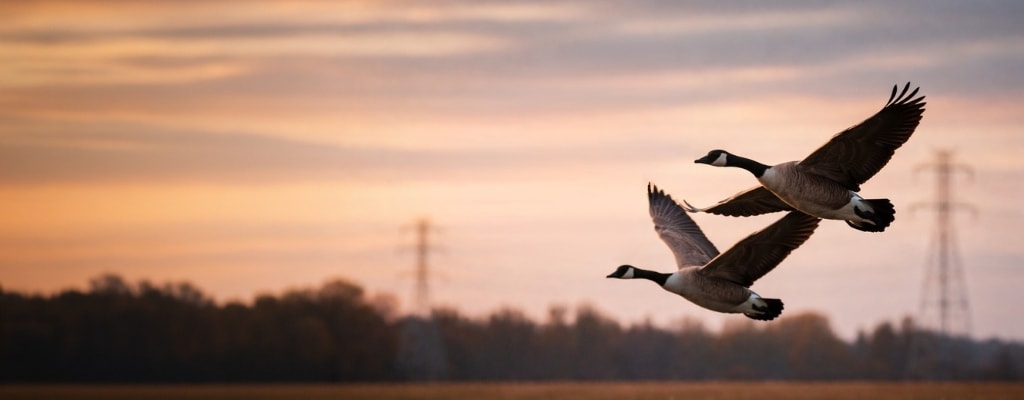
These criteria are especially important for large waterbirds, such as Canada geese and ducks, which can be more vulnerable due to body mass, flight speed, limited maneuverability, and activity during dawn or dusk. Designing for these higher-risk conditions can help improve protection across a broader range of species.
In a study of three 400 kV transmission lines in southern Spain, researchers found that flapper-style diverters were associated with a 70.2%
lower mean avian mortality rate [3]
Deployment Is Becoming More Targeted and
Data-Driven
Advances in data collection and mapping are enabling more precise identification of high-risk line sections. Utilities are increasingly prioritizing:
• Areas near wetlands and water bodies
• Migration corridors and flyways
• Locations with documented collision activity
Programs such as Germany’s Bird Portal demonstrate how collaboration between grid operators and environmental organizations can support more effective deployment strategies. Developed by NABU, RGI, and German grid operators, the portal enables standardized reporting of bird casualties along power lines. By collecting field data, operators can identify critical line sections, better understand species-specific risks, and prioritize where mitigation measures such as bird protection markers should be installed.
This reflects a broader shift from reactive mitigation to data-driven planning. Instead of applying diverters as generic markers, utilities can target high-risk areas such as wetlands, flyways, water bodies, and renewable energy corridors. Combined with performance-based diverter selection, this approach helps improve environmental outcomes while supporting efficient deployment across expanding grid networks. At the same time, installation methods are evolving. Robotic and drone-based systems are improving safety and enabling efficient deployment on energized lines.
What This Means for Utilities and Developers
The next phase of avian collision mitigation will be shaped by performance-based decision-making. Instead of specifying generic markers, utilities can evaluate diverters based on measurable criteria such as detection distance, contrast, movement, and species-specific visibility.
This approach can help utilities:
• Reduce collision risk in high-priority areas
• Support permitting and stakeholder expectations
• Improve deployment efficiency
• Strengthen environmental performance across expanding grids
As grid infrastructure continues to grow, avian protection will become an increasingly important part of responsible power delivery.
Engineered Solutions for Real-World Deployment
As diverter selection becomes more performance-based, utilities need solutions that connect science with field practicality.
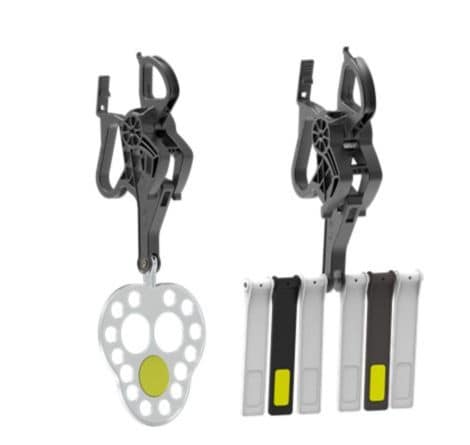
TE Connectivity’s AVFD Avian Flight Diverters are designed to help utilities reduce bird collisions while supporting overhead line reliability. Installed directly on overhead conductors, AVFDs enhance line visibility so birds can detect power lines earlier and change direction. TE’s AVFD portfolio includes models tailored to different visibility conditions, including high-contrast reflective components and photoluminescent elements for low-light visibility.