
White Paper
Your Connection to the Next Generation
Explore how next-generation automotive E/E architectures are reshaping vehicle design. Discover the connectivity solutions, software-defined vehicle technologies, and architectural innovations driving the future of connected, electrified mobility.
Consumer and societal demands for greater safety, electrification, digital-life integration and connectivity have been driving an increasing number of electronic functions within vehicles, leading to ever-growing complexity in the electrical/electronic (E/E) architecture.
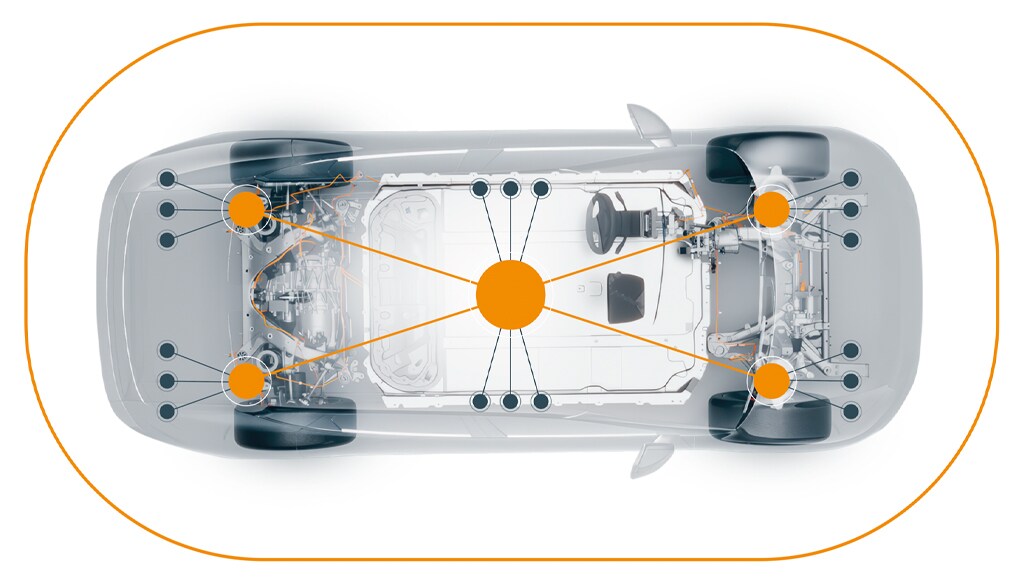
This is causing vehicle OEMs to introduce “smarter” architecture designs featuring centralized more powerful control units organized into distinct zones, providing more modern computing structures that enable server-based software processes.
This approach not only streamlines the wiring harness, reducing its weight and complexity, but also paves the way for more scalable and flexible vehicle designs and functional deployment.
A key enabler of this transformation is connectivity. In these next-generation E/E architectures, robust and high-speed communication networks are essential to ensuring seamless cross-functional data exchange between zones.
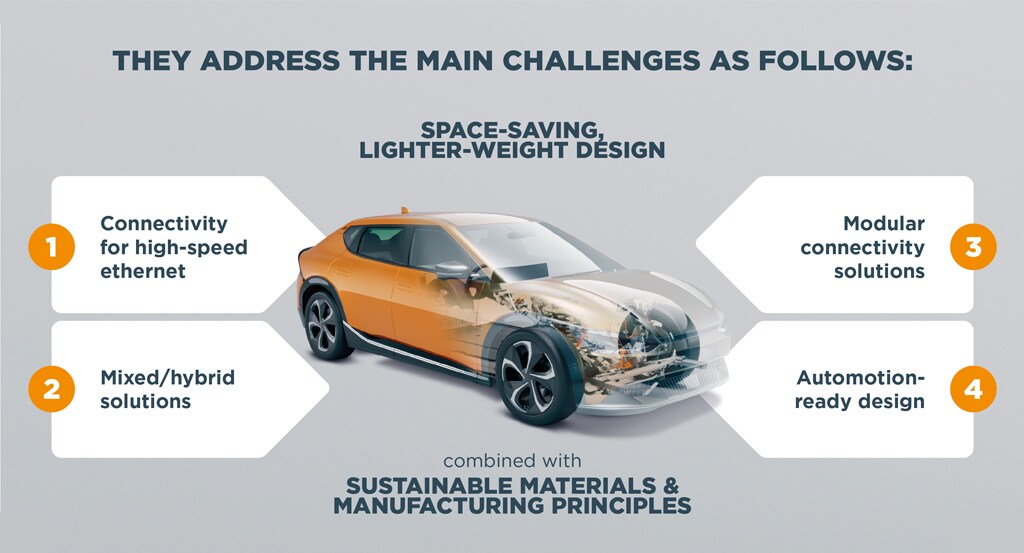
Moreover, connectivity technology will need to provide space-saving solutions to serve the higher number of connections across fewer high-power control units, while providing a greater level of modularity to support more flexibility and automated assembly processes.
Key Topics
- Software-Defined Vehicles (Sdvs) Address New Consumer Demands And Open New Business Models For Oems
- Connectivity For High-Speed Data Links
- The Importance Of Emi Shielding
- TE’s Next-Gen Solutions That Simultaneously Save Space And Reduce Complexity
- Modular Solutions
- Inside Device Connectivity
- In-Device Solutions
- Automation-Ready Design
- Gripping Feature
- Net-Ax+ Modular Hybrid Data Connector
- Pressfit Solutions
- Power Supply For High performance Computers
- 48v Ready Connectors
The Consumer Perspective: Paces
Today’s sophisticated car buyers no longer base their purchase decisions on the same criteria as 10 years ago. The cars they want now must provide personalization and the ability to integrate one’s digital life into the mobility experience; automated and autonomous features for greater safetyand comfort; constant connectivity to the surrounding environment; electrification; and sustainability. The car is no longer the status symbol it once was: some consumers may only participate in ‘shared mobility’ and alternative transportation models. For OEMs to retain market share, they will need to provide the right mix of forwardlooking, immersive and interactive driving experiences, both physical and digital.1.
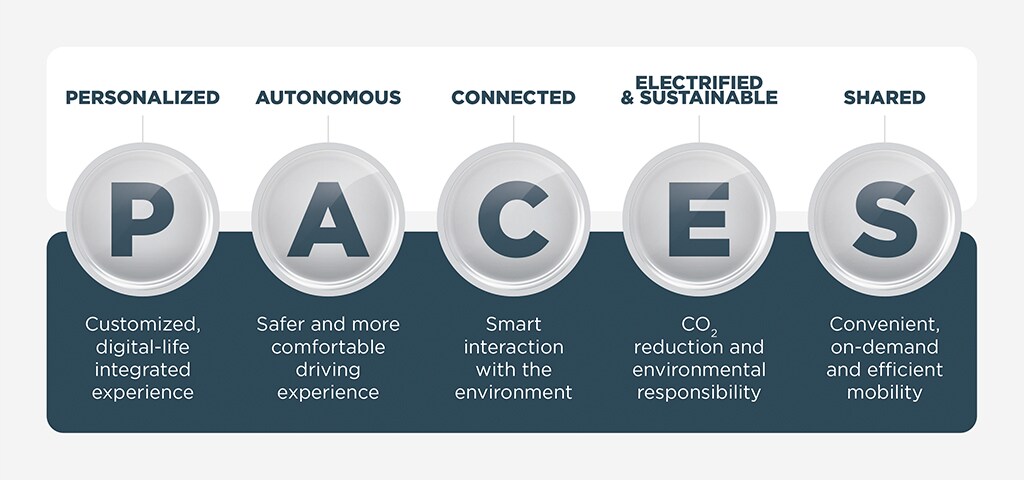
This paper looks at how today’s automotive trends are impacting the evolution of vehicle technologies and what the consequences will be for E/E architectures.Specifically, it focuses on the connectivity solutions that serve these new architectural concepts.
Software-Defined Vehicles (SDVs) Address New Consumer Demands And Open New Business Models For OEMs
Although changing mobility attitudes threaten to disrupt automotive markets and supply chains, it is estimated that software-enabled features – provided on demand –have the potential to offer “new business models worth up to $700bn by 2030.”2 The proceeds from such bookable services could compensate for the certain revenue gap caused by the transformation towards a PACES-ready future.
Key to this shift are smarter E/E architectures that reorganize and simplify the wire harnesses to support more efficient, higher-speed transmission and real-time processing of vastly more sensor and environmental data. The objective is fewer nodes/ECUs but significantly more connection opportunities (ports) per node – linked together by a high-speed data backbone.
‘Zonal’ next-generation architectures will have significant implications for vehicle manufacturing. As zone-based installation approaches replace unwieldy, vehicle-spanning harnesses, it becomes possible to use lighter cabling systems, which enhance electrical efficiency, reduce weight and simplify harness installation and, due to better partitioning, automated harness production becomes an option.
Next-Gen E/E Architecture
Is literally at the heart of this transformation. Just a decade ago, a car’s central nervous system was still largely made up of point-to-point wirings between controllers and actuators. But the addition of all the new functions of modern cars on top of the standard set has brought the traditional wiring harness to the limits of its ability to expand. It has grown too complex, too unwieldy, and too expensive to make.
As the critical weak link in the development chain, it must evolve. But how? In a thousand different ways! Whether fully centralized computing, ‘domain’ or ‘zonal’ control, a little of each or something in between – every automaker will take their own approach. We think of it simply as ‘next-gen E/E architecture.
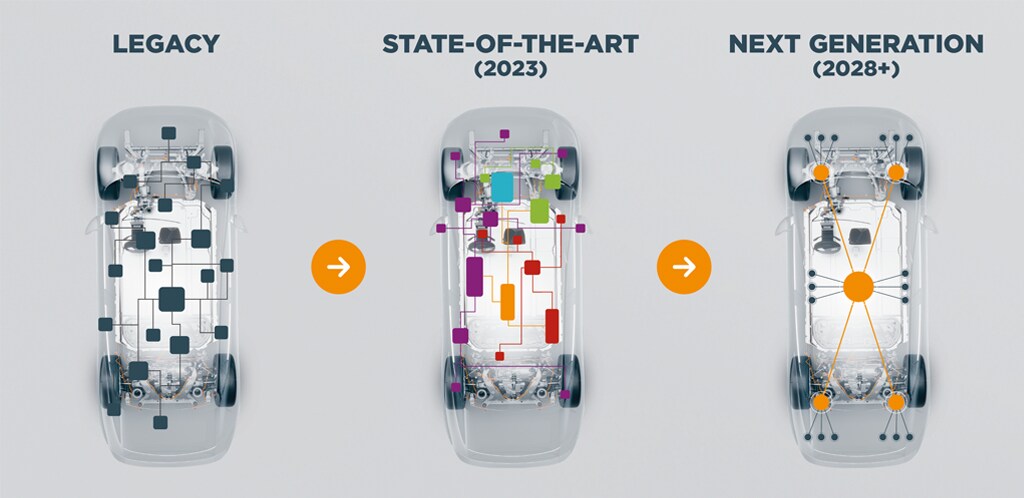
Architectural Characteristics
| Legacy | State-Of-The-Art (2023) | Next Generation (2028+) |
|---|---|---|
| Multiple configurations, low scalability and heterogeneous structures | Structured in functional domains | Zone-oriented, vehicle-centric topology with powerful HPCs and ZCs |
| Up to 150 nodes with low port density | Fusion of nodes and increasing port density, e.g., domain controllers/central gateways | High port densities on HPCs and ZCs with multi-hybrid data, signal and power configurations |
| Data rates up to 6 Gbps, e.g., SerDes point-to-point links | Broad Ethernet adoption up to 100 Mbps and SerDes up to 12 Gbps | Inter-zonal, high-speed Ethernet (10 Gbps) backbone and high-speed SerDes (24 Gbps) |
| Data and power pre-dominantly separated | Power over data line and/or coax | Increase reqs. for integration and autom. production |
Connectivity Design Drivers
| NUMBER OF NODES | NUMBER OF PORTS (PER NODE) | ||
|---|---|---|---|
| High Speed Connectivity | Smart/ Integrated Solutions |
Multi-Hybrid Data, Signal and Power Solutions |
End-to-End Automated Production Ready |
| Miniaturization | |||
Streamlined architectures also reduce the need for model-specific wiring, with functional complexity transferred to software hosted on a few centralized high-power computers (HPCs). Once standardized, components like sensors and motors can be swapped out or added, easing development efforts.
Still, it remains a challenge to cope with the increasing connector footprint on the zone controllers and centralized HPCs: some design concepts require dozens of differential and coaxial ports, in addition to connections for signal and power. Here, modular and multi-hybrid data connectivity solutions play a role. They integrate coaxial and differential data ports with signal and power connections in a single, compact connector assembly that fits onto a PCB –without risking crosstalk or electro-magnetic interference (EMI).
While this physical restructuring is meant to address the ballooning complexity caused by 100 years of packing features into a vehicle, it also makes it possible to pre-equip a car for future upgrades. Via over-the-air (OTA) updates, SDVs can continue to add – as paid subscription services – value and functionality long after leaving the production line, without needing to have any hardware installed or changed.3 A simple illustration of bookable upgrades already being offered by select OEMs is the momentary activation of more performance, more battery range or higher levels of autonomous driving.
Before they roll off the Factory Floor, SDVs require a full hardware stack comprising all the antennas, sensors and actuators to support OTA updates, as well as all the high-performance computing units required for the split-second decisions of advanced driver assistance systems.
Next-Gen Connectivity For Next-Generation E/E Architectures
Of course, before the owner of an SDV can subscribe to a higher level of autonomous driving, for example, the vehicle must already meet the technological requirements for it. This includes high-performance data communications and robust, purpose-engineered connectivity.
The enhanced technology stack required to deliver the personalization and flexibility promised by SDVs can do nothing without robust, high-performance connectivity.
At TE Connectivity, our mission is to ensure that tomorrow’s connectivity is faster, more secure, more reliable – and able to handle the exploding volumes of data and signals. Our connectivity solutions are not only smarter and smaller than ever, they’re also better at multi-tasking, such as transmitting signals and power alongside high-speed data. And they’ve been designed from the start with automation readiness and sustainability in mind.
Connectivity For High-Speed Data Links
Over the next five years, zonal E/E architectures will further consolidate the number of port-dense nodes by connecting diverse but co-located vehicle functions to nearby zone controllers or gateways that, in turn, link to HPCs. The communication within this zonal architecture resembles a computer network, utilizing highspeed Ethernet (10 Gbps) data rates for interzonal communication between the vehicle’s central processing units and the zonal executives.
The growth in data seems only to accelerate. For example, vehicle LiDAR technology currently relies primarily on scanning LiDARs, operating at 1 MP/s and producing max. 1 Gbps data stream. Soon, though, solid-state LiDARs with higher resolution are expected to become standard. While existing scanning LiDARs use unshielded differential connectors, future solid-state LiDARs will employ shielded systems.
Next generation vehicles may also need more than 10 cameras. They’ll be smaller in size and have higher resolution (around 12 MP) producing a data volume corresponding to about 12 Gbps (SerDes4) Additionally, tight space constraints for cameras, may drive the adoption of hybrid data/power connectors integrated right into the housing.
Further more, tomorrow’s vehicles may include ultra-high-resolution displays (such as 8K, pillar-to-pillar screens) and enhanced consumer interfaces. Connectivity requirements for displays and consumer interfaces will likely increase to support up to 20 Gbps (SerDes) compared to today’s 6 Gbps and 1 Gbps, respectively, plus power supply. These intuitive human machine interfaces (HMIs) are important because they extend the mobile digital services inside the vehicle and support powerful consumer devices that enable seamless visual, acoustic and tactile interaction with both the vehicle and the external environment
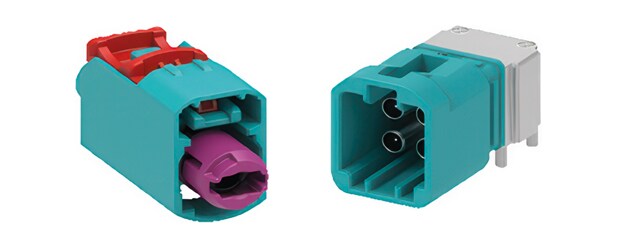
MATE-AX Miniaturized Coaxial Connector Systems
For Coaxial data transmission, supporting up to 9 GHz bandwidth with a 75% PCB footprint reduction.
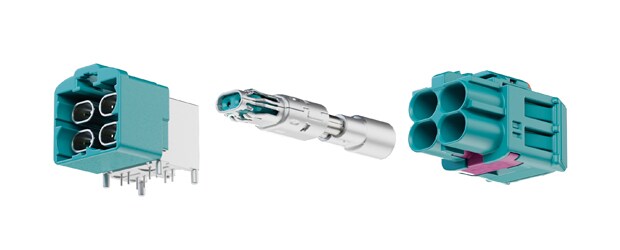
GEMnet Multi-Gigabit Automotive Differential Connectors
Shielded Connectors designed for multi-gigabit Ethernet and SerDes applications, supporting up to 56 Gbps and 15 GHz bandwidth.
The Importance Of EMI Shielding
Next generation automotive E/E Architecture include a wide range of electronics, many of which have a high risk of propagating Electromagnetic Interference (EMI).
It is critical to consider EMI/RFI shielding solutions that effectively reduce susceptibility to electronic malfunctions by either blocking external electromagnetic waves or preventing the emission of internal electromagnetic waves that could interfere with surrounding circuits or devices. Such malfunctions could range from the innocuous, such as an odd noise on a car radio to more serious incidents, such as accidents resulting from the failure of safety equipment.
As vehicles integrate more advanced electronics, effective EMI shielding to addresses vulnerabilities at all levels of design from the PCB layout to the enclosure ensuring signal integrity, reduces cross-talk, and maintains reliable operation of safetycritical functions.
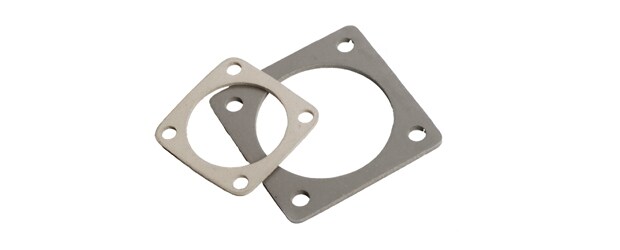
EMI Shielding Materials
TE Connectivity offers a broad portfolio of EMI shielding materials including conductive elastomers, connector gaskets, fabric-overfoam and conductive foams that are designed to optimize performance and compliance in advanced driver assistance and other critical automotive systems.
TE’s Next-Gen Solutions That Simultaneously Save Space And Reduce Complexity
Automotive connectivity technology will need to provide space saving solutions that accommodate the higher number of connections across fewer high-power control units.
Mixed/Hybrid Solutions
E/E architecture consolidation and centralization features a growing number of connectors on the zone controllers and the HPCs.
This can necessitate numerous differential and coaxial data ports, along with multiple connection interfaces for signals and power to the same device. Since traditional connectivity solutions are based on separate discrete connectors for each connection type, this proliferation can present significant spatial challenges on the PCB.
Multi-hybrid connectivity solutions take a different approach: coaxial and differential data ports are integrated with the signal and power connections into a single, compact connector assembly. Shielding ensures no crosstalk or EMI.
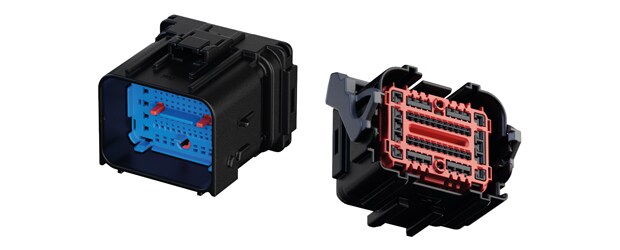
GenY 68P Sealed Hybrid Inline Connector For Signal, Power And Data Miniaturization
Miniaturization = smaller PCB footprint = fewer individualconnections required in the vehicle harness.
Reduced complexity in harness manufacture improves packaging |and wire routing.
Ready for automated processing, simplifying supply chain complexity and reducing cost.
Modular Solutions
In addition, modular hybrid connector systems can further reduce complexity as well as overall PCB footprint and weight, compared to the stack of individual connectors needed to achieve the same functions.
Using interchangeable housings and headers to accommodate multiple interfaces for signal, data and power, individual modules can be fitted together and ‘clicked into’ a common frame. No matter the internal configuration, the external dimensions remain consistent.
In the case of TE’s Modular Hybrid Connector System (MHS), each connector module is based on interfaces that have been approved by OEMs and meet automotive requirements for robustness (temperature/vibration) and connection assurance.
MHS: Modular Hybrid Connector for NextGen E/E Architectures
Especially suitable for zone control units, combining multiple different modules for signal, power and data connectivity in a single connector, reducing space and weight by up to 40%.
Based on qualified TE low-voltage terminal systems, manufactured using sustainable resins and optimized surface technology.

Inside Device Connectivity
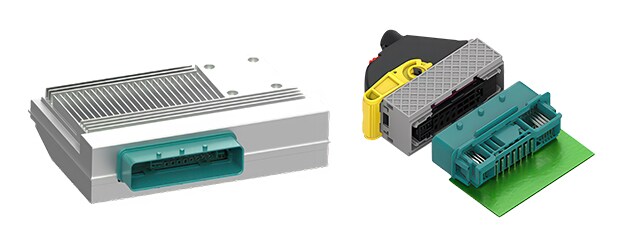
As smarter modular hybrid connector solutions enable the size reduction of in-vehicle control units and other devices, the connections within the devices themselves will play an increasingly significant role. In-device connectivity enables communication and data exchange, often between PCBs, within the device itself.
The future of car architecture includes transitioning to zonal and centralized computing models, replacing the traditional distributed ECUs. Inside Device Connectivity is essential for zonal controllers, facilitating communication between zonal controllers and connected subsystems as well as centralized rocessors, enabling a unified framework where a central processor can access data from all sensors and actuators. Finally, an effective Inside Device Connectivity framework reduces complexity by minimizing redundant wiring and components, therefore ensures reduced weight, simplified maintenance and manufacturing flexibility.
As cars evolve into smart, autonomous, and electrified systems, the importance of Inside Device Connectivity grows exponentially. It is the backbone of future vehicle architectures, enabling real time communication, advanced features, enhanced user experiences, and greater efficiency.
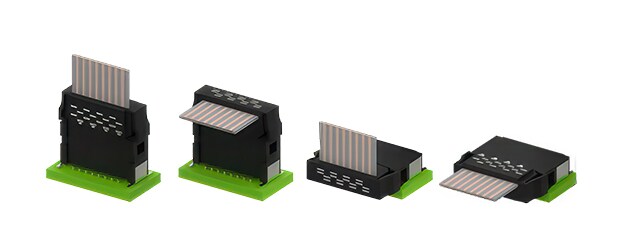
In-Device Solutions
Flex-To-Board
Between flexible and rigid printed circuit boards (FPCBs /PCBs), for example, necessary in power conversion and battery systems.
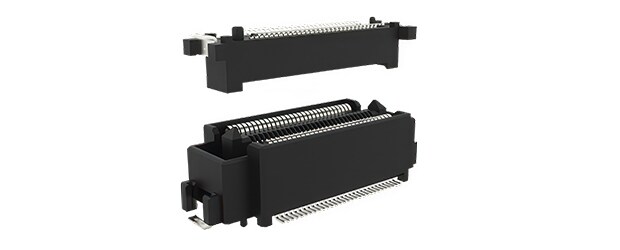
Board-To-Board
Between different printed circuit boards (PCBs) within a system, as used in heads-up displays, electronic mirrors and headlamps, for example (rigid and floating versions available).
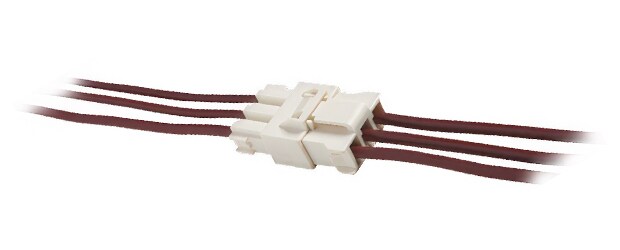
Wire-To-Wire
Connecting individual wires together without using a harness, to allow power and signal routing between different components. These can be found in MAIN controllers for infotainment, HVAC and navigation systems, HPCs.
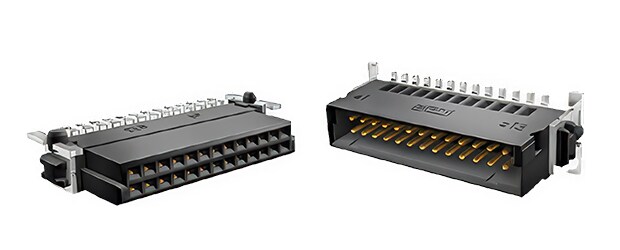
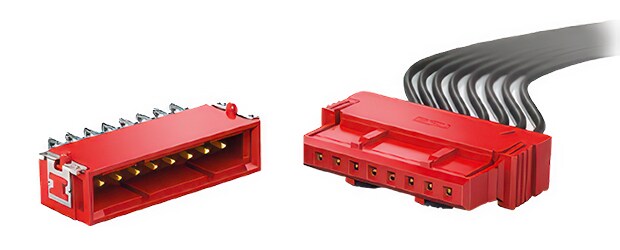
Wire-To-Board
Between wires and PCBs. They consist of a plug attached to the wire and a receptacle soldered directly onto the PCB for secure electrical connections.
Automation-Ready Design
Because of their complexity, wiring harnesses are still largely built by hand in lower cost countries, then shipped to assembly plants for manual installation. But that is beginning to change. ARENA20365 recently released the first edition of the DIN norm for automation of the production of wiring harnesses, DIN 72036:2024-06.6 This norm spells out ‘design guidelines’ for increasing the automation readiness for all the components throughout the cabling. While DIN 72036 currently focuses on low-voltage wiring harnesses, with plans to extend to high-voltage harnesses and to explore digital interoperability, it may ultimately evolve into a family of standards covering all aspects of wire harness automation.7
As a member of the ARENA2036 working group for SILS (Standarisierungsinitiative Leitungssatz, or Standardization in the Field of Automation of Wire Harness Production), TE has been an active participant in the advancement of this effort.
Gripping Feature
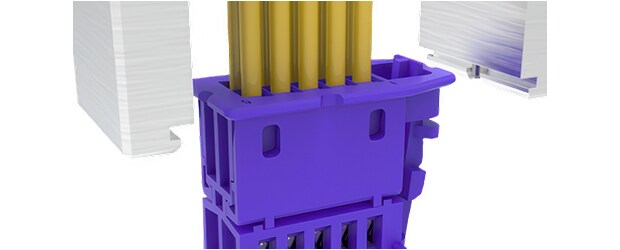
TE’s range of modular connector modules has already been validated for automated assembly readiness and are designed and manufactured using the latest sustainable materials and recycling processes.
By way of example, traditional connectors were designed with defined gripping surfaces for handling or manipulation. To address this, standardized gripping ribs are incorporated, ensuring precise positioning of the connector within the robot grippers. The design allows the robot grippers to access the connector from all directions, enabling flexible handling and easy assembly, regardless of the approach angle.
Such a design ensures precise and secure mating with the electrical device; minimizing the risk of damage and improving overall process reliability.
The efficiency gains and reduced labor costs of increased automation enables assembly closer to the point of use. Furthermore, near-shoring can drastically cut much of the shipping currently needed for harness manufacturing, in turn mitigating associated supply chain risks.
Safety-critical functions (such as ADAS and AD) demand exacting production control, achievable only through digitized processes and components. Coherent traceability, facilitated by virtual representations stored as digital twins, represents a significant improvement over today’s fragmented data islands. Closing the data gap for harness manufacturing is crucial for seamless documentation of quality assurance and ASIL compliance parameters.
Automated robotic assembly may in turn allow for further miniaturization of components such that they would be too difficult for human fingers to manipulate; this would potentially eliminate the need for manual lever systems or secondary locks. The consequent reduction in material directly translates into smaller and lighter-weight components and, ultimately, savings in greenhouse gases.
NET-AX+ Modular Hybrid Data Connector
Especially suitable for high-performance computers, supports coaxial and differential data connectivity for multigigabit Ethernet, SerDes and other application protocols. Can integrate signal and power connections.
Up to 40% PCB space reduction, 56 Gbps speed, and 85% fewer mating assemblies.
Pressfit Solutions
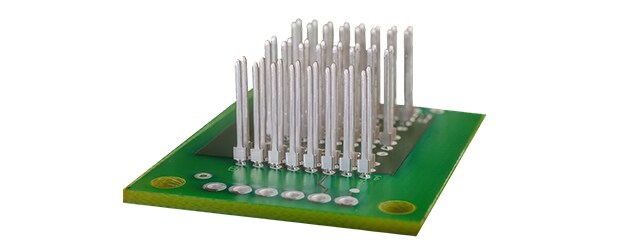
Press-fit pins are crucial in automotive zonal architectures, as they enable reliable, solderless electrical connections in high-density, high performance environments.
In zonal architectures, which consolidate electronic control units (ECUs) to optimize vehicle wiring and communication, these pins provide robust mechanical and electrical connections between circuit boards and connectors. They offer enhanced durability under vibration, thermal cycling, and other stresses typical in automotive applications. Additionally, press-fit technology ensures efficient assembly, reduces manufacturing costs, and supports environmentally friendly processes by eliminating the need for solder, making them essential for modern automotive design.
Power Supply For High Performance Computers
The evolution of next-generation E/E architectures also brings new challenges in power supply and connectivity for high-performance automotive computers. With the computing demands of new high-performance computers reaching 500W to 1000W, power distribution must be optimized to ensure reliable operation and efficient energy transfer in addition to the packaging challenges presented by a greater concentration of functions in the device.
With the increased use of racked or stacked PCB architectures in digital zonal partitions, in-device board-to-board power distribution is required to ensure multiple layers receive stable power without excessive heat generation. While integrated hybrid solutions combining signal, data, and power connections are gaining traction, separate “discrete” connections for high power remain a reasonable approach due to topology redundancy and functional safety concerns.
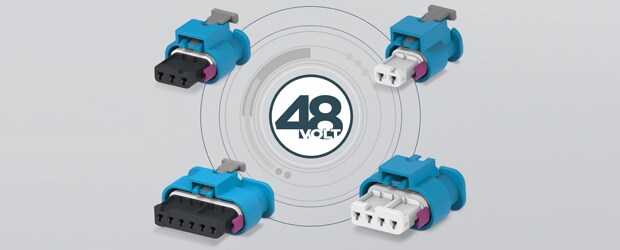
In this regard, the industry is currently on a learning curve to define optimal to pologies that meet the high safety requirements of central data processing structures, ensuring an uninterrupted power supply to critical data systems. As power demands continue to rise, transitioning from traditional 12V systems to 48V architectures presents a possible solution, reducing current levels, minimizing resistive losses, and improving overall efficiency. This shift enables better thermal management and supports scalable, high-power computing platforms while aligning with the evolving needs of software-defined vehicle architectures.
Today, TE Connectivity already has an extensive portfolio of 48V ready connectors but continues to actively research and develop connectivity innovation, enabling the transition to high-performance, high efficiency computing architectures while maintaining the highest standards of safety, reliability, signal integrity, and design flexibility.
48V Ready Connectors
TE’s portfolio of robust 48V ready connectors fulfils industry requirements for sealing and provides the necessary clearance and creepage distance.
While Te Connectivity Doesn’t Design Cars Or The Systems That Run Them, We Do Make The Connections That Enable Them
Advancements in autonomous driving, personalized user experiences, and connected vehicle features aim to meet changing consumer expectations (PACES). To address the associated complexity, automotive OEMs are transitioning from traditional point-to-point distributed E/E architectures to highly centralized, networked structures. Task-dedicated domain electronic control units (ECUs) are being replaced by more powerful centralized control units; instead of physical convolution and component duplication, software streamlines and manages the diverse functions.
This transformation will comprise an advanced and complex hardware stack, including sensors, antennas, actuators and high-power computers – all of which are dependent on smart, robust and high-performance connectivity. For this reason, TE Connectivity offers an extensive range of cutting-edge connectivity products and technologies developed for the requirements of next-gen E/E architectures. They include high-speed data, modular-hybrid, and miniaturized connector systems that are designed from the start for smart manufacturing processes and robotic assembly and are produced according to high sustainability specifications.
Sensor fusion and centralized data processing have made the sensors themselves less ‘intelligent’, so they transmit lots of raw, highresolution data directly to the zonal controllers. Thus, the data connectors must be smarter and more integrated, accommodating high-speed data, power and multiple types of signals within a compact, multi-functional, port-dense component.
TE Connectivity’s automotive connector portfolio combines best-in-class, market-compatible automotive products with breakthrough solutions designed specifically for the demands of next-gen automotive E/E architectures. We have vast experience in responding to OEMs’ and Tier 1-2 suppliers’ past requirements; over the decades, we’ve developed and produced a huge range of innovative solutions. In addition, our deep expertise and the tools we’ve developed for mechanical and electrical design and manufacture – across all current and next generation E/E architectures – qualify us for highly effective collaborations with our customers at each step of the innovation process.
TE Connectivity offers an extensive range of cutting-edge connectivity products and technologies developed for the needs of zonal and next-generation E/E architectures. These include high-speed data, modular-hybrid, and miniaturized connector systems that are automation-ready and designed and manufactured according to high sustainability specifications.
te.com/automotive
TE Connectivity, TE, TE connectivity (logo), GEMnet, MATE-AX, NET-AX+, MATEnet, and EVERY CONNECTION COUNTS are trademarks owned or licensed by the TE Connectivity plc family of companies. Other logos, product and/or company names may be trademarks of their respective owners.
The information given herein, including drawings, illustrations and schematics which are intended for illustration purposes only, is believed to be reliable. However, TE Connectivity makes no warranties as to its accuracy or completeness and disclaims any liability in connection with its use. TE Connectivity‘s obligations shall only be as set forth in TE Connectivity‘s Standard Terms and Conditions of Sale for this product and in no case will TE Connectivity be liable for any incidental, indirect or consequential damages arising out of the sale, resale, use or misuse of the product. Users of TE Connectivity products should make their own evaluation to determine the suitability of each such product for the specific application.