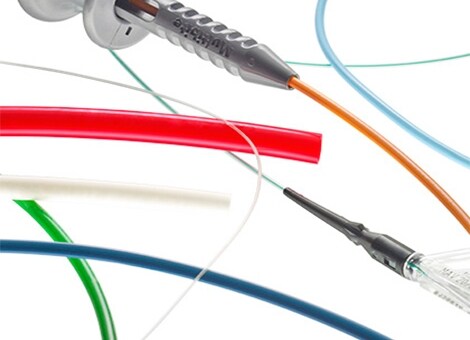
Electrical Isolation for a Precision Surgical Ablation Device
This case study highlights how TE partnered with the customer to deliver a polymer solution that enabled safe electrical isolation in highly constrained anatomical environment.
Challenge
A medical device manufacturer was developing a high-precision PFA catheter designed for accurate device delivery within a beating heart. The dynamic nature of cardiac motion created significant engineering challenges, requiring a solution that could maintain precision and stability in a constantly moving environment.
The device required:
- Advanced navigation capabilities to maneuver within complex cardiac anatomy
- Reliable performance despite continuous motion and anatomical interference
- Miniaturization to support precise device placement
- Tight dimensional tolerances to ensure consistency and accuracy
Balancing flexibility, dimensional control, and material performance at micro-scale dimensions was critical to the catheter’s success.
Solution
TE Medical partnered with the customer to engineer a thin-wall polymer solution that balanced electrical performance, flexibility, and manufacturability.
Key elements of the solution included:
- Ultra-thin wall extrusion withtight tolerances on both wall thickness and inner diameter (ID)
- Material selection optimized for flexibility, enabling smooth navigation within confined joint spaces
- Superior dielectric properties to support a smaller device tip while maintaining safe electrical isolation
- Low coefficient of friction, improving maneuverability and minimizing tissue interaction
Two material platforms were selected based on performance requirements:
- MT-PBX (Pebax®-based solution)
- MT-2000 (HDPE-based solution)
Both materials provided the necessary mechanical recovery and electrical performance to withstand installation stresses while maintaining dimensional stability.


Results
The final solution delivered strong electrical isolation performance without sacrificing flexibility or recoverability.
MT-PBX (Pebax-based):
- Dielectric strength: 800volts/mil
- Installed thickness: 3/1000 in., recovering to 4/1000 in.
MT-2000 (HDPE-based):
- Dielectric strength: 1000volts/mil
- Installed thickness: 6/1000 in., recovering to 10/1000 in.
These results enabled the customer to develop a device capable of safely accessing and treating small joints while minimizing the risk of nerve damage and tissue disruption.

Capabilities
TE Medical’s polymer extrusion expertise supports demanding surgical applications requiring precision, performance, and speed to market.
Core capabilities demonstrated in this project include:
- Thin-wall extrusion for both Pebax (MT-PBX) and HDPE (MT-2000)
- Tight tolerance control on wall thickness and ID
- Materials engineered for flexibility with superior dielectric strength
- Low-friction surfaces to enhance device navigation
- Rapid sample turnaround to accelerate device development
By combining advanced materials science with precision manufacturing, TE Medical helps customers solve complex electrical isolation challenges in next-generation surgical devices.
Conclusion
Designing surgical devices for small joint applications demands a careful balance of flexibility, electrical performance, and dimensional precision. Through advanced thin-wall extrusion and material expertise, TE Medical delivered a polymer solution that enabled safe electrical isolation in highly constrained anatomical environments. The collaboration resulted in a high-performance ablation device capable of navigating complex joint structures while protecting surrounding nerves and tissue. By combining innovative materials with precise manufacturing capabilities, TE Medical continues to support medical device manufacturers in bringing safer, more effective technologies to market.