
Application
Liquid Cooling Sensors for Intelligent Data Center Control
TE Connectivity sensors enable real-time pressure, temperature, and liquid level monitoring—keeping systems efficient, reliable, and ready to scale.
The race to adopt artificial intelligence (AI) is transforming data center infrastructure in real-time. Global hyperscalers, cloud providers, colocation operators, and enterprises are adopting liquid cooling strategies to cool AI and high-performance computing HPC workloads as rack densities continue to rise and outpace the limits of air-only cooling architectures. These organizations may retrofit existing facilities or build net-new, depending on the business case. Liquid cooling is growing at double-digit rates year over year, and direct-to-chip (D2C) cooling solutions constitute nearly half of current market share.
Industry leaders are working together to set standards for advanced AI computing infrastructure. Technology and infrastructure companies, such as NVIDIA, AMD, Google, Amazon, Vertiv, nVent, Boyd, and TE Connectivity, participate in the Open Compute Project (OCP), collaborating to advance open standards and guidelines for nextgeneration data center infrastructure. As rack computing density grows, liquid cooling will become the dominant solution, requiring new methods of ensuring precision control. IT and infrastructure teams follow a complex process to deploy cooling infrastructure by assessing workload demand, reviewing power and heat transfer needs, and evaluating various approaches for data center environments.
As part of this process, these teams must also decide which D2C architecture best meets their needs in achieving PUE targets – Power Usage Effectiveness, a metric that quantifies total facility energy use relative to IT load – whether liquid-to-air (L2A) or liquid-to-liquid (L2L).
They will need to implement equipment, including coolant distribution units (CDUs), manifolds, cold plates, heat exchangers, piping, filters, and tooling. In addition, teams must plan for ongoing monitoring and maintenance.
CDU Coolant Circulation
CDUs provide continuous coolant circulation and are critical to maintaining server uptime. Coolant, typically deionized water or a water-glycol mixture such as PG25, is circulated within a closed Technology Cooling System (TCS) loop. Often referred to simply as the secondary loop, it includes pumps, filters, heat exchangers, expansion tanks, piping, manifolds, and cold plates that remove heat directly from IT components. The coolant is actively controlled in both flow rate and temperature, ensuring stable operating conditions and efficient heat removal across varying IT loads. In liquid-to-air (L2A) CDUs, heat is rejected to the surrounding air using heat exchangers with integrated fans.

For higher cooling demands, liquid-to-liquid (L2L) CDUs transfer heat to a separate facility water system (FWS) via the heat exchangers. This primary loop, supplied by chillers or other heat rejection systems, enables significantly higher heat removal capacity while keeping the TCS coolant loop isolated.
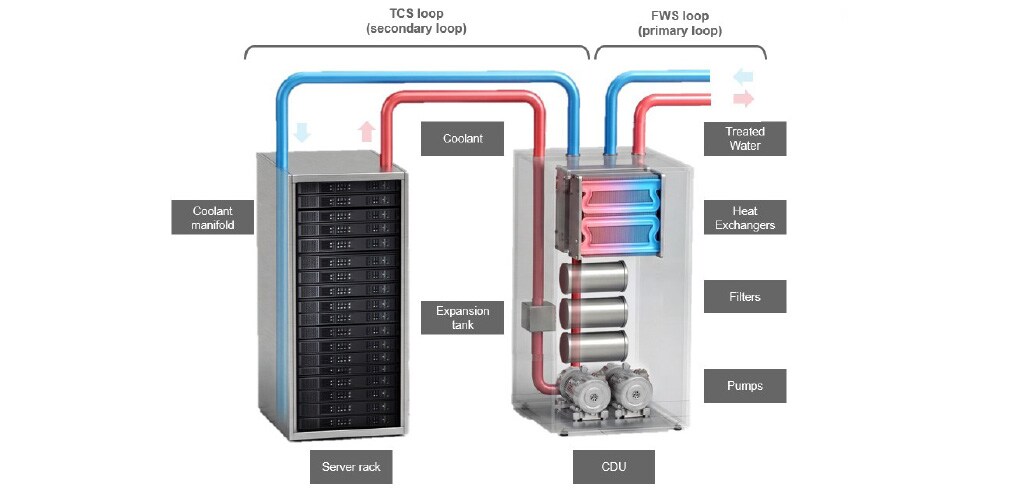
In-row L2L CDU architecture example
High operation uptime is achieved through N+1 redundancy and hot-swappable design of key components (such as pumps, filters, etc.), enabling maintenance without interrupting operation. As coolant loops become more complex and distributed, detecting hidden failure modes can help teams prevent issues ranging from pressure instability to micro-leaks, air bubbles, dry-run pump conditions, and the degradation of coolant quality over time.
If undetected, these operating conditions can negatively impact cooling efficiency, destabilize pump operation, and ultimately compromise the health and performance of multi-million-dollar GPU clusters. Sensors are an essential tool in protecting liquid cooling systems from instability and failure – in addition to helping optimize their performance. But they need to be aligned to different use cases across facility and technical loops to meet the desired levels of accuracy, performance, and cost.
UNLOCK EXPERT INSIGHTS
White Paper
- Why liquid cooling is becoming essential: Understand the shift from air cooling to liquid-based systems for high-density environments.
- Key challenges in liquid cooling systems: Learn about design, monitoring, and operational risks that impact performance and reliability.
- Role of sensors in thermal management: Discover how sensing technologies provide real-time data, early fault detection, and system optimization.
- How to improve uptime & efficiency: Explore strategies to prevent failures and ensure consistent system performance.
- Design considerations for next-gen infrastructure: Insights into building scalable, future-ready cooling architectures for AI and HPC.
This video explores how TE Connectivity’s pressure, temperature, and ultrasonic lliquid level switches provide the awareness needed to keep liquid-cooled data centers stable, efficient, and scalable. High-precision pressure sensing that stabilizes pump performance, to advanced ultrasonic level sensing that delivers reliable readings even in aerated liquids, TE sensors are engineered for the unique demands of modern data center thermal management.

About the Author
Alexandru Istrate, Senior Principal Systems Architect
Alexandru brings system‑level experience across sensor technologies used in high‑reliability industrial platforms, with a focus on long‑term architecture needs and technology trends in areas such as semiconductor manufacturing, advanced thermal management and data center cooling, robotics, and condition monitoring.