AMPSEAL 16 Connector Series
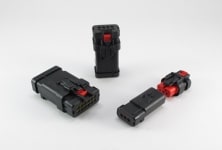
AMPSEAL 16 Connectors
Q: What is CPA on AMPSEAL 16 connectors?
A: CPA stands for Connector Position Assurance. After mating AMPSEAL 16 connectors, the CPA slides into place as a secondary lock. It helps reduce the chance of accidental unlatching in high vibration environments such as engine compartments, construction equipment, and heavy-duty vehicles.The CPA works with the primary latch to provide an additional mechanical safeguard. This supports secure connector engagement during shock and vibration, which is common in industrial and commercial transportation applications
Q: What is TPA in AMPSEAL 16 connectors?
A: TPA means Terminal Position Assurance. In AMPSEAL 16 connectors, the TPA is integrated into the housing as a Primary Latch Reinforcement feature.
After crimped contacts are inserted into the housing, the TPA is pushed into its final locked position. This helps confirm that each contact is fully seated and helps prevent contact back-out under vibration or mechanical stress
Unlike connector systems that require separate wedgelocks, AMPSEAL 16 connectors integrate this function into the one-piece housing design.
Q: What temperature range do AMPSEAL 16 connectors support?
A: Standard AMPSEAL 16 connectors operate from -40°C to +125°C.
High-temperature AMPSEAL 16 connectors extend this range up to +150°C and meet UL94 V-0 flammability requirements. These variants are designed for on-engine, aftertreatment, and powertrain applications where elevated temperatures are common.
Q: Are AMPSEAL 16 connectors sealed against water and dust?
A: Yes. AMPSEAL 16 connectors are designed to meet IP67 ingress protection. With rear protection or backshells installed, they can achieve IP68 and IP6K9K performance in demanding environments
Sealing is achieved through:
- A silicone interface seal between plug and cap
- Individual wire seals at each cavity
- Optional cavity plugs for unused positions
- This multi-layer sealing approach helps reduce the risk of moisture, dust, and overspray entering the connection.
Q: What current and voltage ratings do AMPSEAL 16 connectors support?
A: AMPSEAL 16 connectors use HDSF and DEUTSCH solid size 16 contacts rated up to 13 amps per circuit, depending on wire gauge. They support 14–20 AWG (2.50–0.50 mm²) wire sizes and are rated up to 250 V DC
Actual allowable current depends on wire gauge, contact plating, and thermal conditions.
Q: How do AMPSEAL 16 connectors help reduce harness assembly time?
A: AMPSEAL 16 connectors feature a fully assembled one-piece housing with integrated TPA and CPA.
Because the terminal lock and connector lock are built into the housing, there are no separate wedgelocks or secondary components to install. This can help reduce assembly steps, simplify industrialization, and support consistent quality in high-volume harness production
Q: What wire sizes and cavity counts are available?
A: AMPSEAL 16 connectors are available in 2, 3, 4, 6, 8, and 12 positions.
They support 14–20 AWG wire sizes and provide standard and reduced wire seal options depending on insulation diameter
This allows engineers to select the appropriate configuration based on current requirements and harness layout.
Q: How durable are AMPSEAL 16 connectors in service?
A: AMPSEAL 16 connectors are rated for 50 mating cycles per SAE J2030 and are tested to withstand 21 G RMS vibration from 25 to 2000 Hz for 20 hours per axis
This supports stable electrical performance in high vibration applications such as engines, transmissions, and off-highway equipment.
Q: How do I disassemble an AMPSEAL 16 connector?
A: Disassembly can mean two different actions:
• Unmating the connector (separating the two halves)
• Depinning the connector (removing contacts from the housing)
Q: How do I unmate the connector?
A:
1. Release the secondary lock (CPA) so the main latch can move.
2. Press the primary latch and pull the two halves apart in a straight line.
Tip: If the connector does not separate easily, check that the secondary lock is fully disengaged before applying force.
Q: What is the secondary lock (CPA)?
A: It is a safety feature that prevents accidental unmating. It must be released before the main latch can be disengaged.
Q: How do I remove contacts from the connector (depin)?
A:
1. Remove any rear accessories such as a backshell or conduit support.
2. Remove the terminal position assurance (TPA) from the housing.
3. Insert a contact extraction tool into the cavity to release the retention feature.
4. Gently pull the wire from the rear until the contact is removed.
Q: What tool is needed for contact removal?
A: A dedicated contact extraction tool sized for the contact system is recommended to properly release the retention feature without damaging the housing.
Q: What should I do if the contact will not come out?
A:
• Recheck tool alignment inside the cavity
• Make sure the retention feature is fully released
• Avoid pulling with excessive force, as this can damage the connector or seals
Q: How do I reassemble the connector after depinning?
A:
1. Insert the contact until it locks into place.
2. Reinstall the TPA to secure all contacts.
3. Remate the connector and re-engage the secondary lock.
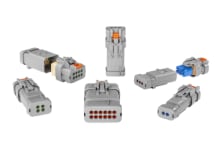
AMPSEAL 16 Connector Housings
AMPSEAL 16 Connector Housings
Q: What are AMPSEAL 16 connector housings used for?
A: AMPSEAL 16 connector housings are used to build sealed wire-to-wire and wire-to-device connections in harsh industrial and commercial transportation environments. They accept size 16 contacts and support 2 to 12 circuits per connector.
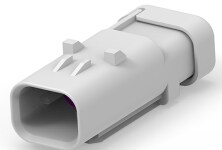
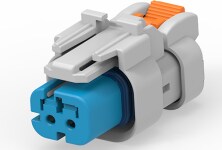
Q: What is the difference between a plug housing and a cap housing?
A: Plug and cap housings are the two mating halves of the AMPSEAL 16 connector interface. One side typically contains pin contacts and the other contains socket contacts. Selection depends on harness design and mating orientation requirements.
Q: What does CPA mean on an AMPSEAL 16 connector?
A: CPA stands for Connector Position Assurance. It is a secondary locking feature that engages after mating and helps reduce the risk of accidental unmating in high-vibration applications.
Q: What does TPA mean?
A: TPA stands for Terminal Position Assurance. It helps confirm that each contact is fully seated inside the housing, which can reduce the chance of a backed-out terminal during assembly or service.
Q: What temperature range do AMPSEAL 16 connector housings support?
A: Standard versions operate from −40°C to +125°C. High-temperature variants operate up to +150°C and are suited for hotter zones such as engine compartments and aftertreatment systems.
Q: What ingress protection rating is supported?
A: AMPSEAL 16 connector housings are designed to support IP67 environmental sealing. When used with appropriate rear protection and accessories, higher ingress protection performance can be supported depending on configuration.
Q: What wire sizes are supported?
A: The system supports 14–20 AWG conductors using HDSF size 16 contacts. Seal selection depends on wire insulation outside diameter.
Q: How do I select the correct housing configuration?
A: Selection typically involves confirming:
- Position count (2, 3, 4, 6, 8, or 12)
- Temperature grade (standard or high temperature)
- Keying code (A, B, C, or D)
- Wire seal type (standard or reduced diameter)
- Plug or cap orientation
Q: Can I request a sample?
A: Yes. Select the required AMPSEAL 16 connector housing part number and open the individual product page. From there, use the “Get Free Samples” option to begin the request process.
AMPSEAL 16 Connector Backshells
AMPSEAL 16 Connector Backshells
Q: What is an AMPSEAL 16 connector backshell?
A: It is a snap on accessory that mounts to the rear of an AMPSEAL 16 connector and helps guide the harness exit. Smooth exit designs include tie wrap slots, and corrugated exits support conduit based routing.
Q: What is the difference between 180° and 90° backshell kits?
A: 180° kits route the harness straight out of the connector rear. 90° kits route the harness to the side and use an elbow design that supports 360° rotation.
Q: What does low profile mean for the 90° option?
A: The catalog lists a low profile right angle backshell kit type. Engineers typically use it when space around the connector is limited and the harness still needs a side exit.
Q: How do I choose smooth wire exit versus corrugated tubing exit?
A: Choose smooth wire exit when you are bundling wires with tie wraps near the connector. Choose corrugated tubing exit when the harness uses conduit for routing and abrasion management.
Q: What conduit sizes are supported?
A: The catalog Alias system lists NC08/NW7.5, NC12/NW10, NC16/NW13, and NC20/NW17 as conduit options. Match the backshell outlet to your conduit size.
Q: What temperature range applies to these backshells?
A: The TE category page lists an operating temperature range of -40°C to 125°C for this backshell family.
Q: Do backshells change ingress protection rating?
A: Backshells add rear side coverage and cable management features. Overall ingress protection depends on the full connector configuration and how rear protection is applied in the harness.
Q: How do I request samples for a backshell kit?
A: Select a backshell part number from the product list on this page. Open the part detail page and use the sample request option when it is available for that part.
AMPSEAL 16 Connector Backshells
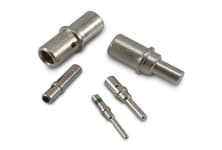
AMPSEAL 16 Connector Contacts
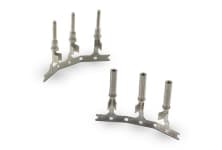
Q: What are AMPSEAL 16 connector contacts used for?
A: They are size 16 crimp contacts used within the AMPSEAL 16 connector system for sealed wire-to-wire and wire-to-device connections in harsh transportation environments.
Q: What wire sizes are supported?
A: AMPSEAL 16 connector contacts support wire sizes from 14 to 20 AWG. Each part number specifies a more precise sub-range within that band.
Q: Why is insulation diameter important?
A: The insulation support barrel must properly grip the wire jacket. Selecting a contact with the correct insulation diameter range helps reduce conductor flexing near the crimp.
Q: What does HDSF mean?
A: HDSF stands for Heavy Duty Stamped and Formed. It describes the construction method used for the size 16 contact system in this connector series.
Q: What retention performance is listed?
A: The published specification includes a 111 N axial load contact retention test.
Q: What are the crimp tensile strength targets?
A: The page lists minimum tensile targets of 90 N for 18 AWG, 120 N for 16 AWG, and 180 N for 14 AWG.
Q: Do I need sealing plugs for unused cavities?
A: Yes. Open cavities can allow contaminants into the connector system. Sealing plugs should be used in unused positions to maintain environmental sealing performance.
Q: Can I request samples?
A: Yes. Select the required AMPSEAL 16 connector contact part number and use the sample request option on the product detail page when available.
AMPSEAL 16 Connector Sealing Plugs
AMPSEAL 16 Connector Sealing Plugs
Q: What is an AMPSEAL 16 connector sealing plug?
A: It is a non-conductive plug used to fill an open connector cavity. It supports the environmental seal when a cavity is not populated with a contact.
Q: Why do unused cavities matter in harsh environments?
A: TE notes that open cavities can provide pathways for contaminants to enter the connector. Filling unused cavities helps maintain seal integrity.
Q: How do I choose size 16 versus size 20 cavity?
A: Match the sealing plug to the cavity size used in your connector configuration. This page lists both size 16 cavity and size 20 cavity options.
Q: What does “standard or reduced diameter cavities” mean here?
A: AMPSEAL 16 connector sealing plugs on this page are listed as compatible with standard or reduced diameter cavities. Match this to your connector’s cavity and seal design.
Q: How do I install sealing plugs during assembly?
A: TE’s assembly guidance describes inserting sealing plugs from the rear into empty cavities and pushing them until they sit flush. The TPA then helps lock them in place during final assembly.
Q: Where do I get drawings and 3D files?
A: Open the part number page for the sealing plug. Part pages provide product drawings and 3D files.
Q: Can I request samples?
A: Many individual sealing plug part pages support “Get a sample” or similar actions, depending on availability and login status. Select a part number from the list, then request samples on the part page when that option is shown.
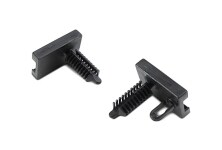
AMPSEAL 16 Connector Mounting Clips
AMPSEAL 16 Connector Mounting Clips
Q: What do AMPSEAL 16 connector mounting clips do?
A: They install on the receptacle to mount the connector in the vehicle chassis or under the hood.
Q: What does anti rotation mean for this clip family?
A: It refers to a feature that helps resist twisting after the connector is mounted. The catalog lists a mounting clip option with an anti rotation post.
Q: How do I choose between 1924487-1 and 1924487-2?
A: Use 1924487-2 when you want the anti rotation feature. If you do not need that feature, 1924487-1 is the standard option.
Q: When is 1924487-3 a better fit?
A: The catalog lists 1924487-3 as an 11 mm clip height option, which can help when clearance is limited.
Q: What material and flammability rating are shown for these clips?
A: PA material and UL 94HB for these mounting clips.
Q: How do I request samples?
A: Open the part page for the clip you need and use Get Free Samples when that option is available.
AMPSEAL 16 Connector Applications
Applications
Q: What is an AMPSEAL 16 connector?
A: Our AMPSEAL 16 environmentally sealed connectors are designed for cable to cable and cable to device applications. AMPSEAL 16 connectors are used in harsh environment applications where even a small degradation in connection may be critical.
Q: What are the appropriate applications for AMPSEAL 16 connectors?
A: Truck, Bus, Off-highway, Construction, Agriculture, Mining, Emergency Vehicles, Forestry, Recreational, Marine, Motorcycle.
Q: When should I use AMPSEAL 16 connectors?
A: AMPSEAL 16 connectors provide reliability and performance on the engine or transmission, under the hood, for motor controllers, solenoid interfaces, on the chassis, or in the cab. AMPSEAL 16 connectors offer field-proven reliability and rugged quality. Rectangular, thermoplastic housings offer a wide operating temperature range and silicone rear wire and interface seals allow the connectors to withstand conditions of extreme temperature and moisture.
Q: What are the key benefits of using AMPSEAL 16 connector backshells in industrial and commercial transportation?
A: AMPSEAL 16 connector backshells are designed to provide environmental protection, strain relief, and durability for electrical connections in rugged environments. They safeguard connectors from dust, water, and mechanical stress, helping reduce wire fatigue and enabling reliable performance. Their flexible design options, including 90° and 180° configurations, simplify cable routing and integration into complex wiring systems.
AMPSEAL 16 Connector Key Features
Key Features
Q: What are the AMPSEAL 16 connectors’ key features?
A: AMPSEAL 16 Connector Key Features:
- Accepts contact size HDSF 16 (up to 13 amps)
- 14-20 AWG (2.50-0.50 mm2)
- 2, 3, 4, 6, 8, and 12 cavity arrangements
- In-line mount
- Rectangular, thermoplastic housing
- Integrated latch for mating
- Integrated Primary Latch Reinforcement (PLR) confirms contact alignment and retention
Q: What configurations and options are available for AMPSEAL 16 connector backshells?
A: AMPSEAL 16 connector backshells are available in both 90° and 180° configurations to suit different cable routing needs. The 90° versions allow for 360° rotation, providing versatile wire management. Options include smooth wire exits with integrated tie-wrap slots for strain relief or corrugated tubing exits for added cable protection. These backshells are compatible with all AMPSEAL 16 connectors in 2, 3, 4, 6, 8, and 12 positions.
Q: How do AMPSEAL 16 connector backshells support applications in high-temperature environments?
A: AMPSEAL 16 connector backshells are built to operate in challenging thermal conditions, with high-temperature variants supporting up to 150°C. This makes them suited for use in engine compartments, after-treatment systems, and other applications where connections are exposed to elevated temperatures. Their robust thermoplastic construction provides long-lasting performance even in extreme environments.
AMPSEAL 16 Connector Performance / Specifications
Performance/ Specifications
Q: What is the temperature range for AMPSEAL 16 connectors?
A: Operating at temperatures -40°C to +125°C
Q: How durable are AMPSEAL 16 connectors?
A: 50 cycles. Note: Shall meet visual requirements, show no physical damage, and meet requirements of additional tests as specified in Product Qualification and Requalification Test Sequence in Figure 3 of TE product document 108-2184.
Q: What is the insulation resistance for AMPSEAL 16 connectors?
A: 20 megohms minimum. SAE J2030 6.3. Insulation resistance at 1000 volts DC adjacent terminals measured after 60 seconds or until stabilization occurs.
Q: What is the immersion rating for AMPSEAL 16 connectors?
A: IP67 rating
Q: What is the vibration rating for AMPSEAL 16 connectors?
A: No discontinuities. EIA-364-28 Subject mated specimens to 21 G’s rms between 25 to 2000 Hz. Twenty hours in each of three mutually perpendicular planes. Note: Shall meet visual requirements, show no physical damage, and meet requirements of additional tests as specified in Product Qualification and Requalification Test Sequence in Figure 3 of TE product document 108-2184.
AMPSEAL 16 Connector Materials
Materials
Q: What material are AMPSEAL 16 connector shells made of?
A: AMPSEAL 16 connector shells are made of rugged 15% Glass filled thermoplastic.
Q: What material are AMPSEAL 16 connector PLRs made of?
A: AMPSEAL 16 connector PLRs are made of rugged 15% Glass filled thermoplastic.
Q: What material are the AMPSEAL 16 connector seals made of?
A: The AMPSEAL 16 connector seals are made of silicone rubber.
 e
e
 e
e
 e
e
 e
e
 e
e
 e
e
 e
e
 e
e
 e
e