Load Cell Types
Learn more about the characteristics of the most common load cell form factors.
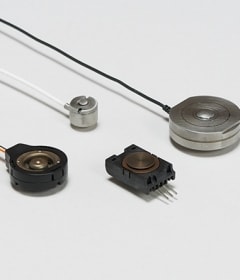
Load cells are available in a variety of mechanical configurations, each designed to suit specific force directions, mounting constraints, and application environments. While the sensing technology determines how force is converted into a signal, the form factor governs how that force is applied and measured. Below are the most common load cell types used across industrial, laboratory, and structural applications.
Form Factors

Pancake Load Cell
Axial force compresses the flat, disk-shaped body of a pancake load cell. The central diaphragm responds by deforming symmetrically, allowing embedded strain gauges to detect the change and produce a proportional signal. The wide footprint distributes stress evenly, minimizing sensitivity to off-center loads. High-capacity systems such as press monitoring and structural testing rely on pancake load cells for their low profile and excellent stiffness.

S-beam Load Cell
Tension or compression applied to the threaded ends of an S-beam load cell causes the central bending section to deflect. The curved body concentrates strain in the narrow neck, where strain gauges measure the deformation and generate a differential signal. Suspended weighing systems, tensile testers, and force calibration rigs use S-beam load cells for their bidirectional capability and compact geometry.

Load Pin
Shear force travels through the cross-section of a load pin when it replaces a structural pin in clevises, sheaves, or lifting assemblies. The cylindrical body transmits the load while embedded strain gauges measure the resulting strain. Cranes, hoists, and mobile lifting systems rely on load pins to monitor force without altering mechanical geometry.

Through-hole Load Cell
Compressive force passes through the central hole of a washer-style load cell, deforming the surrounding ring. The radial or axial strain activates sensors embedded in the body, which produce a signal proportional to the applied load. Bolt preload monitoring, clamping force measurement, and space-constrained assemblies use these compact, through-hole designs.

Shear Beam Load Cell
Transverse force acting near the center of a shear beam load cell induces shear strain within the beam. The body resists lateral deformation while strain gauges positioned at shear stress points detect the internal shift. Floor scales, tank weighing systems, and conveyor monitoring platforms favor shear beam load cells for their rugged construction and resistance to off-axis loading.

Bending Beam Load Cell
Applied force in shear or bending causes a cantilevered beam to flex, concentrating strain in machined pockets where strain gauges detect deformation. The resulting signal reflects the load magnitude. Bending beam load cells are commonly used in platform scales, hopper systems, and industrial weighing due to their compact form and high sensitivity.

Column Load Cell
Axial force compresses the tall, cylindrical body of a column load cell. The structure distributes stress uniformly along its vertical axis, allowing strain gauges to detect the deformation and generate a signal. Structural testing rigs, press load monitors, and heavy industrial weigh stations depend on column load cells for their high capacity and long-term stability.

Canister Load Cell
Vertical force travels through the sealed cylindrical housing of a canister load cell, activating the internal diaphragm or column. The sensing element responds by deforming, and the electronics convert this into a calibrated output. Outdoor scales, silo weighers, and rugged industrial platforms use canister load cells for their environmental sealing and overload protection.
Form Factor Compatibility
Choosing the right load cell form factor is not only about force type. It must also fit the physical and mechanical constraints of the system. Space limitations, load alignment, and integration with existing structures can significantly impact performance and installation complexity. Poor alignment or inadequate clearance can introduce off-axis loading, increase measurement error, and shorten sensor life. Considering these factors early in the design process helps ensure accurate measurements and reliable long-term operation.
Space Constraints
Compact environments such as robotics or medical devices often require low profile designs like pancake or S-beam load cells. Larger industrial systems may accommodate column or canister designs for higher capacity and ruggedness.
Load Alignment
Proper alignment ensures that the applied force follows the intended load path. Misalignment can cause bending stresses and off-axis errors. Designs with symmetrical geometry, such as pancake or washer-style load cells, help minimize these risks.
System Integration
Consider mounting surfaces, bolt patterns, and accessibility for calibration. Retrofit applications may favor load pins or through-hole designs that replace existing structural elements without major modifications.