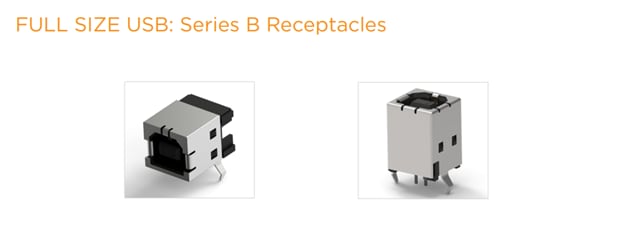
Robust connections for larger peripheral devices
USB Type-B connectors, typically called USB-B connectors, are a kind of Universal Serial Bus (USB) device. These have squarish or thin rectangular shapes with slightly beveled corners on the top ends. Standard USB-B connectors are commonly used on larger peripheral devices that connect to a host computer, remain stationary, and do not require frequent unplugging, such as printers, scanners, and external hard drives. The USB-B connector on a peripheral device is commonly paired with a USB-A or USB-C connector on the host device. USB-B connectors support USB 2.0 speeds (up to 480 Mbps), and in some cases USB 3.0 speeds (up to 5 Gbps).
Other versions of USB-B connectors have been created over the years, including the smaller form factor Mini USB-B, Micro USB-B, and USB 3.0 Micro-B connectors. The USB 3.0 Micro-B connector is designed for higher data transfer speeds and is commonly used to connect external hard drives and other high-speed peripherals to computers. USB 3.0 Micro-B is backward compatible with USB 2.0 but has more pins and a secondary connector extension for USB 3.0 data transfer.
What Customers Ask
USB Type-B Connectors
Q: Which USB connectors are compatible with legacy devices?
Legacy ecosystems still use USB Type‑A and USB Type‑B, and TE continues to support these in multiple PCB and panel configurations. Older mobile devices often use Mini USB or Micro-USB, both available in TE’s portfolio. USB Type‑C adapters allow gradual migration while maintaining legacy support.