
The Importance of Pressure Sensors in HVACR Systems
How TE Connectivity’s Board Mount Pressure Sensors Meet New Performance Standards
Sensors are an integral part of most heating, ventilation, air-conditioning, and refrigeration (HVACR) systems. They help to not only maintain a comfortable indoor climate but also to increase the efficiency of the HVAC systems. They also enable integration of HVAC systems with building automation systems. Traditional HVAC systems used pressure and temperature sensors and switches to control basic operations of the system such as turning it on or off or for opening or closing valves or vents. HVAC equipment designers are facing mounting challenges to create more accurate systems that consume less energy with higher efficiencies leading to a comparable push for much finer control of the various HVAC subsystems. This has led to advances such as variable air volume, variable refrigerant flow, variable speed motors and blowers, electronic expansion valves, and many other control methodologies to finely tune the system and minimize the overall energy use.
Sensors have played a large role in improving the efficiency of these systems by monitoring various components within the system and confirming that all parts are functioning properly. In fact, an ever-increasing number of sensors are being installed in these systems to monitor the process and maintain accuracy. Reliability has become key to providing precise and consistent data.
The most common sensing types in HVACR systems include temperature and pressure along with a strong push toward using humidity sensors as well as gas and other sensing technologies. So, what happens when these sensors aren’t reliable or robust enough? Systems can fail causing thousands of dollars in damages. However, in most situations, sensor failures result in loss of system efficiency, erratic operation, and uneven environmental controls in the building or home.
In some cases, the system provides inadequate cooling or heating and causes comfort issues with personnel, resulting in poor productivity and equipment issues. In a worst-case scenario, when temperatures are critical for computer equipment, food preservation or for medicine, drug or organ maintenance, system issues can contribute to expensive equipment failure or even the loss of life. In addition, service calls to diagnose and repair the issues can be very expensive and time-consuming.
In this paper, we will concentrate our discussion on two vastly different HVAC pressure sensor applications and two vastly different product ranges that TE manufactures, that address some of the challenges faced in this market
Forced Air System Monitoring
Tough Environments Require Rugged, Robust, Reliable Sensors
Pressure applications in HVAC include a range of board mount differential pressure sensors that are used in HVAC systems for filter monitoring as well as pressure monitoring throughout a forced air system. Additionally, heavy duty pressure transducers that are used to monitor refrigerant pressure in compressor-based systems as well as water or other liquid pressures in large commercial chillers and other refrigeration systems.
The environment found in commercial and residential HVACR systems can be one of the most challenging industrial environments. With large temperature swings, high moisture levels, dust and debris and, often, electrical noise, the HVACR system requires sensors that are rugged enough to function continuously while providing accurate and repeatable readings.
For board mount pressure sensors in air handling systems, the temperature range is generally narrow but these differential pressure sensors operate at only a few millibars (few inches of H2O column) to measure volumetric air flow. While air is generally considered to be a relatively benign media to measure, most commercial and residential air handling systems can become quite dusty over time with a range of particulates contaminating the air in some portions of the system.
On the other hand, many of the applications on HVAC equipment are designed to monitor refrigerant or other liquid/gas pressures as part of a cooling or heating system. Depending where in the system the pressure transducer is located, it could see very high or very low temperatures as well as significant and swift swings in temperature as part of the HVAC system. Pressures also tend to be significantly higher than for air handling systems with refrigerant pressures ranging from around 50psi on the low side and 250psi on the high side for R-134a to a low side pressure of about 130psi and a high side pressure of 420psi for R-410a.
Advanced Thermal Technology
Ultra-Low Pressure Measurement
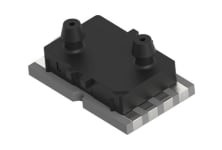
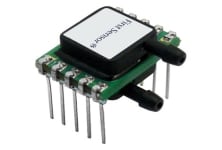
TE offers the LDE, LME and LMI series surface mount and board mount differential pressure sensors that utilize a thermal micro-flow channel technology and are designed for ultra-low pressure measurements. These advanced thermal differential pressure sensors are based on a silicon chip only about 4 mm2 (0.006 in2) in size. The sensors incorporate innovative MEMS technology that integrates a micro-flow channel within the silicon sensor chip. Advanced thermal sensors can measure ultra-low air or gas pressures from 0.25 millibar (0.1 inches of water column) full scale (FS).
Advanced thermal technology features high dynamic ranges and high sensitivities for very low pressures, especially around zero. The sensors offer digital signal conditioning for calibration, temperature compensation, and amplification. They can be optimized to different application requirements depending on whether a high sensitivity, high dynamic range, or linear output signal is needed.
Two of the most significant advantages of advanced thermal technology is its zero-offset accuracy and very high pneumatic impedance. Typically, differential pressure is created in the system by an air velocity probe that converts air velocity into delta-P which is close to the square function of air velocity (or flow). Thermal sensors have excellent (0.1% FS) offset accuracy and long-term stability. The integration of the miniaturized flow channel with the sensor chip enables the advanced thermal pressure sensor to achieve very high pneumatic impedances up to 20,000 to 50,000 Pa/(ml/s). This performance is up to 100 times higher than comparable sensors. The miniaturized flow channel reduces the gas flow through the sensor to an absolute minimum and offers unique application advantages in dusty and humid environments as well as when using long connection tubes, filters, or other pneumatic elements. Even if these elements change their resistance over time, there will be no negative influence on the measurement accuracy. This capability gives the engineer more flexibility in designing the air handling system.
Microfused Technology
Higher Pressure HVAC Measurements
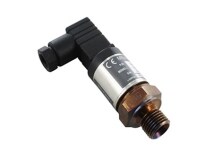
As mentioned before, SMD and board level pressure sensors are ideal for low and ultra-low-pressure measurements for dry non-corrosive gases such as air. For higher pressure measurements and for measuring most types of caustic media a more rugged and sealed pressure sensor is required. TE offers the M3200 series compact pressure tranducer, the latest in a long line of pressure sensors designed and manufactured using Microfused technology. Microfused technology employs micromachined, silicon piezoresistive strain gages fused with high temperature glass to a stainless-steel diaphragm. The technology is a unique construction of the sensor front end made from a single piece of steel. The result is a hermetic fitting that is free from failure-prone welds and o-rings. Bottom line – it’s more reliable. The M3200 is an industrial pressure transducer that reaches a new price performance standard for demanding HVACR pressure applications. Available with a wide range of threaded pressure port and connector options, it has standard pressure ranges available from 100 to 5000psi or 7 to 350bar. The M3200 is designed for ease of installation and reliable performance in harsh environments.

 e
e
 e
e
 e
e