NTC THERMISTOR FAQS
Product Overview
What is a thermistor?
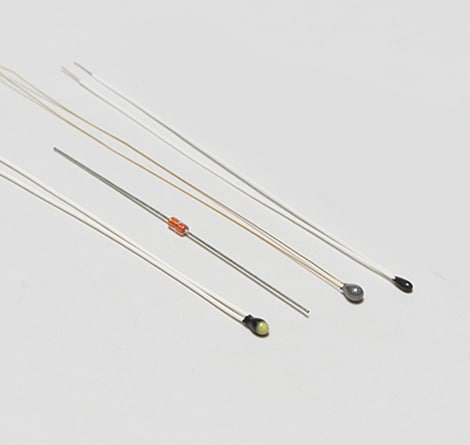
A thermistor typically refers to negative temperature coefficient (NTC) thermistor. An NTC is a high-sensitivity thermal resistor based on a ceramic-based semiconductor composite material. NTC thermistors are characterized by a significant, nonlinear reduction in resistance as temperature increases within their operational range. Typically, the resistance changes by 4% to 5% per degree Celsius. These devices offer precise temperature measurement, rapid thermal response, and a compact footprint, but are limited to a narrower operating range (approximately –40 °C to +150 °C).
There is another class of thermistor called a positive temperature coefficient (PTC) thermistor, these are more commonly used as a heater.
What is the response time of an NTC thermistor?
Response time is defined as the time it takes to reach 62% or a new temperature, and is a function of mass. The smaller the sensor the faster the response. A discrete sensor will respond faster than the same sensor packaged inside a metal housing. Typical response times for an NTC thermistor sensor is <15 seconds.
What is the difference between a thermistor and an RTD?
There are distinctly different technologies within temperature products. Each technology has its advantages and disadvantages and choosing the best one for a specific application will depend upon a number of factors including temperature range, accuracy required, time response, cost and many others. Its best to understand as much as possible about the application in order to determine which product or technology is best suited for the customer.
What is the stability of an NTC thermistor?
Typically, all thermistors are stable at room temperature and below. Temperature cycling primarily affects the stability during high temperature cycles. For example, if a part in an application cycles between 25˚C and 100˚C with equal times at each temperature, then after a year of use the total drift will be similar to 100˚C use for six months. Another factor in the stability of a thermistor are the fabrication methods and encapsulation materials. Glass encapsulated pressed disks and glass beads are the most stable.
What is the thermistor resistance at a given temperature?
The rule of thumb is to use a low resistance sensor for a low temperature application and a high resistance sensor in a high temperature application. The goal is to have a working resistance value in your temperature range of interest.
What is the best practice for gluing a thermistor to a metallic surface?
Adhesives are used in many applications to attach a thermistor for surface temperature measurement. A thermally conductive adhesive, usually epoxy, will give optimal results.
Radiation Exposed Environments
Why are NTC thermistors exposed to radiation?
NTC thermistors may be exposed to high levels of radiation for a variety of reasons:
- Medical patient monitoring probes are often sterilized using high doses of radiation to kill bioactive agents.
- Outer space environment applications in satellites and spacecraft may expose thermistors to extended periods of cosmic radiation or radiation from nuclear thermopiles.
- The nuclear industry may use thermistor-based sensors in various processes for temperature control.
It is therefore desirable to understand the impact of various doses of radiation on the performance and reliability of thermistor-based devices.