-
Product Listing
Substation Feeder Control Units
Product Features
-
Fault Detection : Directional Earth Short Circuit | Directional Short Circuit | Directional Static Earth | Directional Transient Earth | Eart Fault Via Pulse Locating
-
Fault Reset Option : Auto | External Potential-Free Normally Open Contact | Local | Manual | Remote (Modbus) | Time-Controlled
-
Measurement Parameters : Current | Frequency | Power Factor | Voltage
-
Monitoring Options : PD Trend Monitoring | Power Flow Monitoring
-
Control Unit Function : Active Power | Apparent Power | Reactive Power

Retrofit your installation into a smart grid and improve grid reliability with cost-effective solutions
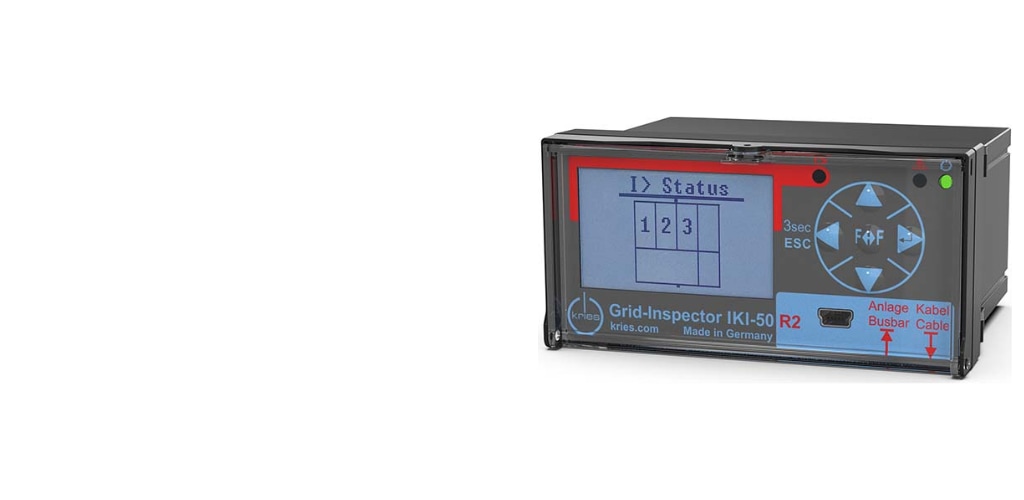
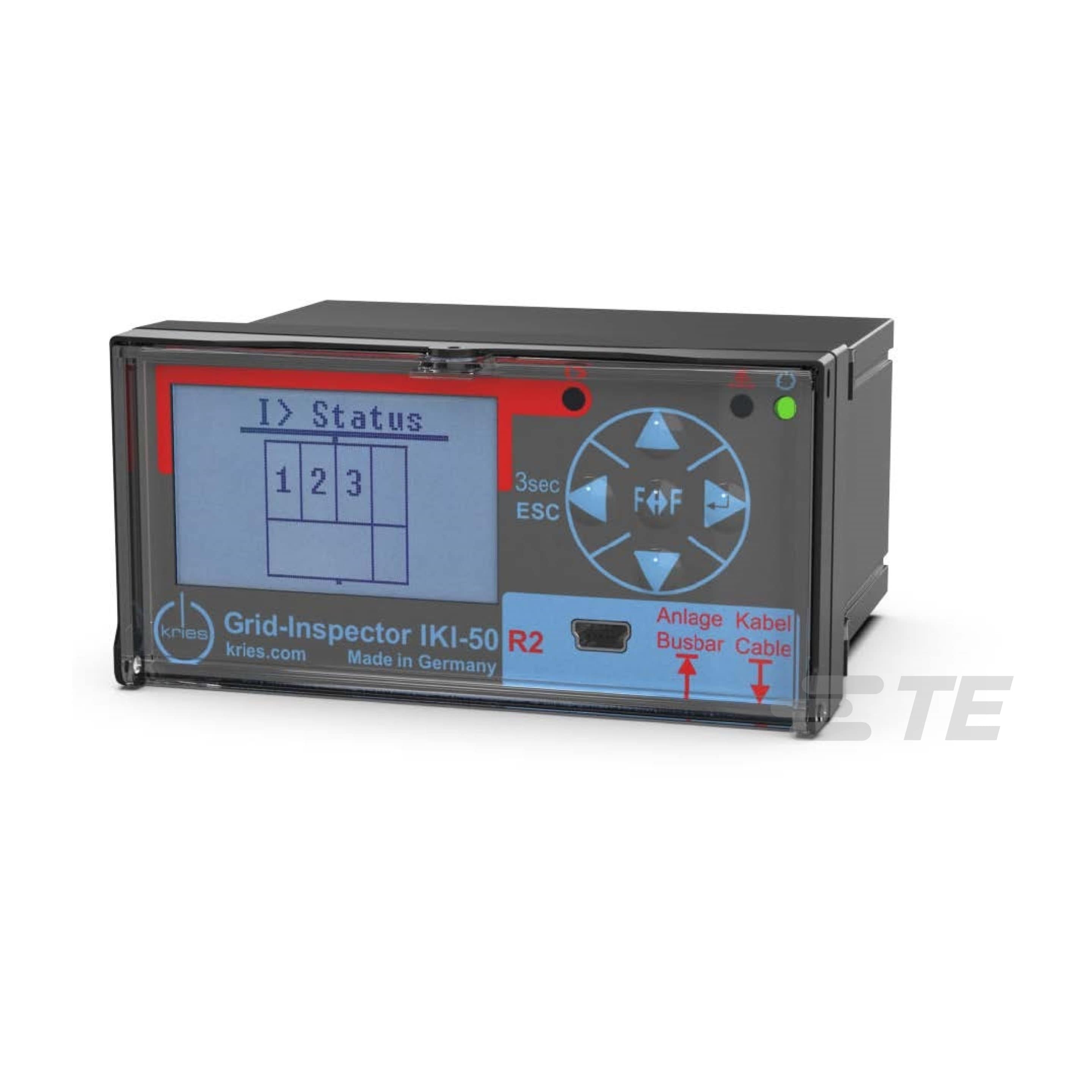
The TE Connectivity (TE) Kries IKI-50 substation control unit is tailored for switchgears and underground distribution and transmission lines from 1 to 52 kV. The IKI-50 is an intelligent solution designed to address the increasing challenges of decentralized energy supply as well as rising demands for power availability and quality in distribution networks. Designed for utility and industrial customers, it provides unparalleled transparency over network parameters such as voltage, current, and power - onsite or remotely, through a SCADA integration system.
Our IKI-50 not only monitors grid parameters from a distance, but also allows the network owner to interact with a switchgear from a control centre. It also allows precise voltage measurement and automatic cross-calibration along the entire secondary substation.
Engineered for durability, the IKI-50 is compliant with IEC and IEEE standards, and its design helps ensure consistent performance in harsh conditions from -25 °C to +75 °C, enhancing grid transparency and reliability while reducing costs.
Customers benefit from increased network transparency and proactive maintenance capabilities, resulting in faster fault resolution and reduced operational costs. The IKI-50 helps network owners provide a continuous, reliable power supply through detailed, real-time data and robust fault management, elevating the efficiency and reliability of energy distribution networks.
Locating a fault in underground networks involves time-consuming trial and error. Discover how directional fault detection delivers precise fault location and direction, reducing intervention time and accelerating service restoration.


Key Features
Power load monitoring
- Enables fault detection, reducing downtime (SAIDI)
- Remote control and precise voltage measurement
- Maintenance-free
- Partial discharge detection with CAPDIS-S2_55
Applications

Frequently Asked Questions
Question: What is a substation or feeder control unit?
Answer: This device is used in electrical power distribution networks to monitor, control, and protect feeder lines. It supports efficient and reliable power delivery by managing the flow of electricity and responding to fault conditions. However, it should be noted that IKI-50 and IKI-55, in particular, are not protection relays; if this is a requirement, we also offer IKI-30 or IKI-35 as appropriate solutions for protecting distribution transformer substations.
Question: Where should a feeder control unit be installed?
Answer: This type of unit should be installed at key points in the distribution network, typically at substations or on feeder lines, to effectively monitor and control the flow of electricity.
Question: Can the IKI-50 detect the direction of a fault?
Answer: If the voltage signal is available, then IKI-50 can detect the direction of a fault. This is a helpful function when searching for faults in loop systems or when information about the locations of transformer substations is missing.
Question: What types of communication protocols are supported by IKI-50 and IKI-55?
Answer: IKI-50 supports Modbus-RTU, whereas IKI-55 supports Modbus-RTU, MQTT, REST, and IEC 60870-5-104, allowing seamless integration with various systems.
Question: Can IKI-50 and IKI-55 perform load management?
Answer: Yes, they can both manage and balance loads across the network, preventing overloading and supporting efficient power distribution.
Question: Can IKI-50 and IKI-55 integrate with SCADA systems?
Answer: These devices are designed to integrate with SCADA systems, providing real-time data and control capabilities to central operators.
Product Vulnerability Reporting
Information about vulnerabilities of this product can be reported and received on this website: te.com/productsecurity.
Please review product documents or contact us for the latest agency approval information.
Product Type Features
-
Monitoring Options PD Trend Monitoring | Power Flow Monitoring
Configuration Features
-
Switching Function Type 1.5 Pole Switching
-
Configuration Method Kries Configuration Software
-
Number of Feeders 1
-
Number of Digital Outputs for 1.5 Pole Switching 6
-
Number of Events Logged 20
-
Control Unit Function Active Power | Apparent Power | Reactive Power
-
Number of Digital Inputs 6
-
Number of Digital Outputs 6
Electrical Characteristics
-
Input Voltage Selection Low-Power Voltage Transformer | Voltage Detecting and Indicating System
-
Current Input Type Current Sensor
-
Current Input Measuring Accuracy (%) 3
-
Power Supply Capacitor | External Auxiliary Supply
-
Current Input Measuring Range (A) .5 – 1158
-
Supply Voltage (V) 24 – 230
Signal Characteristics
-
Frequency Selection (Hz) 50 – 60
Usage Conditions
-
Operating Temperature Range -25 – 55 °C [ -13 – 131 °F ]
-
Storage Temperature Range -25 – 70 °C [ -13 – 158 °F ]
Operation/Application
-
Communication Interface Mini-USB | Modbus RTU (Slave)
-
Measurement Parameters Current | Frequency | Power Factor | Voltage
Industry Standards
-
IP Rating IP54
-
Calibration Type Sensor | Sensor Cross-Calibration
Other
-
Fault Recording Type Event Recording
-
Network Neutral Earthing Inductive Terminated Neutral | Isolated Neutral | Low Ohmic Terminated Neutral | Short Term Low Ohmic Terminated Neutral
-
Fault Recorder No
-
Fault Detection Directional Earth Short Circuit | Directional Short Circuit | Directional Static Earth | Directional Transient Earth | Eart Fault Via Pulse Locating
-
Fault Reset Option Auto | External Potential-Free Normally Open Contact | Local | Manual | Remote (Modbus) | Time-Controlled