
Learning from the Past
The lessons learned from automation provide a roadmap for AI success.
Implementation of automation technologies presented similar challenges and opportunities to those faced by companies adopting AI today. Despite some growing pains during that process, automation ultimately delivered clear gains across a set of objectives remarkably like the ones that businesses have targeted for their AI efforts – including innovation, efficiency and data insights.
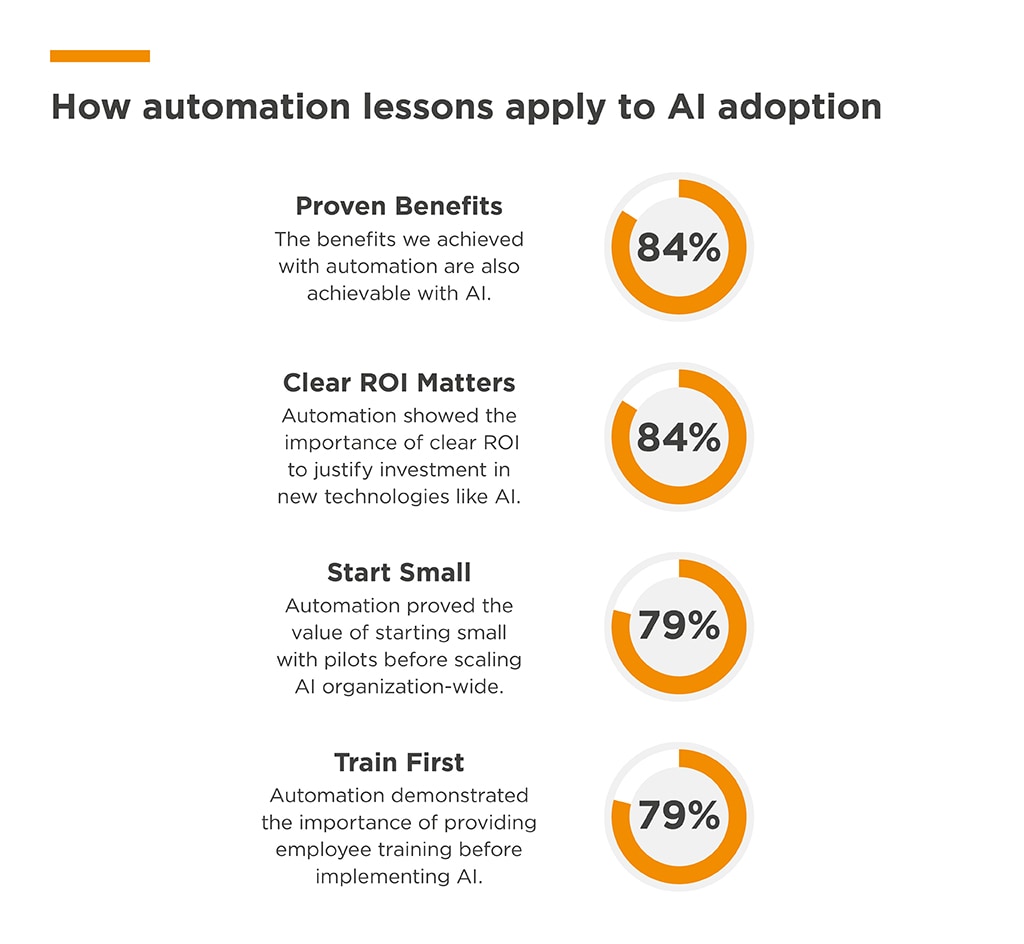
Reflecting on the positives and negatives from that experience, engineers and executives agree that the factors that led to successful automation adoption also provide a good roadmap for AI, such as:
1. Establishing a clear and shared vision for ROI.
2. Using pilot programs to prove the value of new concepts before
scaling them.
3. Training employees to ensure you maximize the impact of each
initiative.
By following those lessons, companies may see even greater impact from their AI adoption efforts: Two-thirds of engineers (66%) and 58% of executives believe AI has the potential to deliver broader benefits than automation.
TE Takeaway
As manufacturing becomes faster and more complex, one lesson from traditional automation stands out: the systems that deliver real value are those that don’t just inspect, but continuously measure, decide and adjust in real time. This closed-loop principle—long established in automation—now directly informs how we design AI-enabled vision systems. Instead of relying on reactive inspections, AI vision pushes us toward in-process monitoring that immediately detects issues like misaligned pins, or some other process issues, and helps to proactively adjust machine parameters to prevent them. Just as automated equipment depends on tuned setpoints and standardized modules, AI vision relies on robust, reusable models and thresholds that stabilize quality and scale quickly across lines. And to sustain this shift, intuitive interfaces and ongoing upskilling empower line leads and engineers to train, refine, and deploy vision models with the same confidence they apply to automation.

Jim Tobojka
Senior Vice President
Global Operations