
Improving Sustainability
AI can serve as an enabling technology to advance sustainability goals.
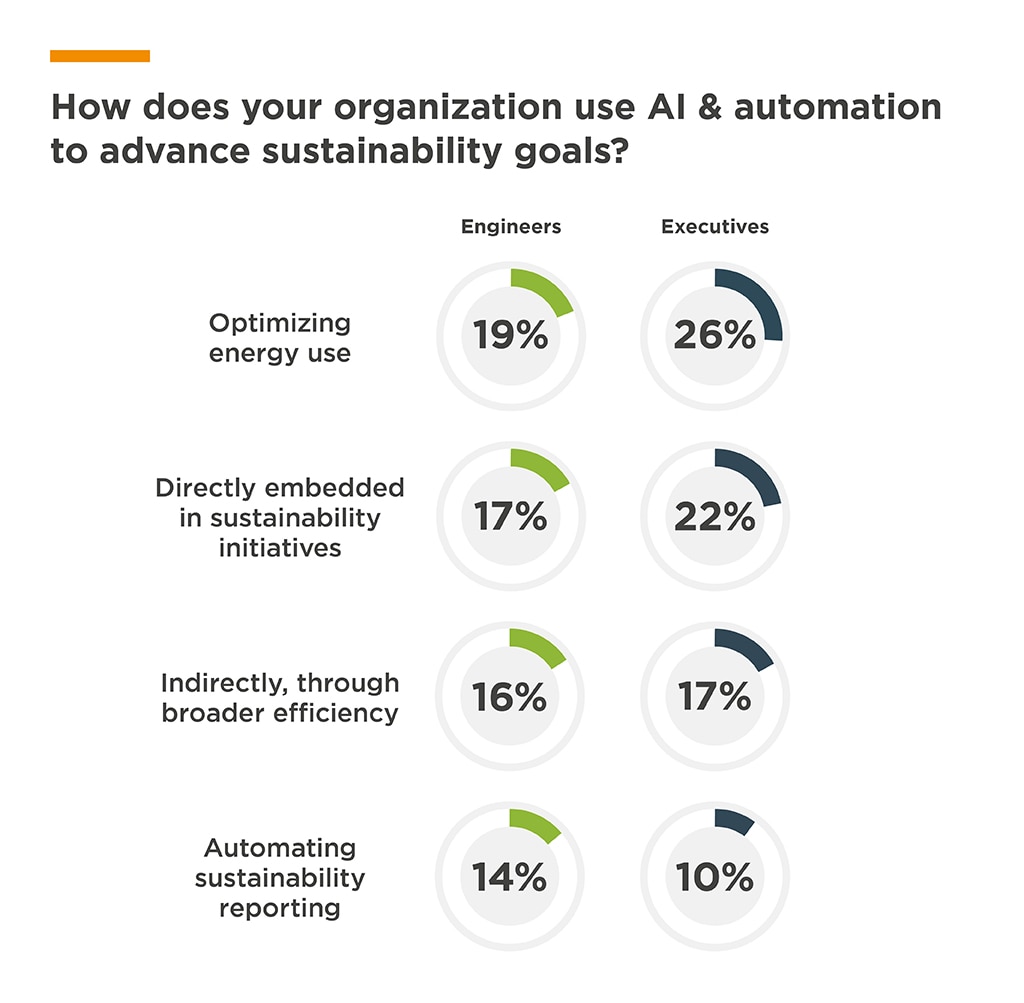
Beyond its potential to deliver innovation and financial benefits, AI can play a role in companies’ pursuit of sustainability goals. In fact, virtually all respondents (99%) say they are using AI and automation to advance sustainability goals in some way.
Despite this widespread adoption, there is little consensus on how AI can best support sustainability goals. For example, optimizing energy usage is the most common sustainability-related application for AI deployments. That use case may be attractive as companies look for ways to respond to public concern around the energy consumed by AI data centers. Still, fewer than a quarter of respondents are currently using AI in this way.
TE Takeaway
One of the most effective examples of AI driving sustainability at TE is our rollout of Digital Environmental Monitoring Systems (DEMS). By combining high frequency metering with machine learning models, these systems learn a site’s real operating baseline, detect anomalies in how buildings and equipment consume energy and water, and highlight hidden opportunities to reduce waste. A great example comes from our Tangier site, where DEMS now integrates data from our onsite solar, purchased electricity, water use, and major production assets. By establishing a precise daily energy baseline, the system highlighted hidden loads during non-production hours. That insight enabled the team to design targeted “shutdown” strategies during planned low activity periods. In one shutdown event alone, Tangier avoided roughly 331 MWh of energy use, and avoided over $40,000 in utility costs--nearly half the cost of the system. Globally, our sites maintain a 3% year-over-year reduction trend in electricity use through focused investments and expanded digital monitoring. As we continue to scale DEMS, we will be able to benchmark sites, replicate high impact actions quickly, and build a consistent, data driven playbook for energy and water management across the company.

Holly Webdale
Vice President, ESG